Jack: Straight From the Gut

In Jack: Straight From the Gut, famed GE CEO
Jack Welch (with John A. Byrne), gives a no-nonsense take on what made his 20-year tenure at GE so successful.

  • The first fundamental in strategy is to be in the right business
    • In his initial speech as CEO in December 1981, Welch asked each of his leaders to be either number one or number two in their businesses.
    • If not, they need to come up with a plan to either fix, sell or close
    • This followed from Peter Drucker’s key questions:
      • “If you weren’t already in the business, would you enter it today?”
      • “If the answer is no, what are you going to do about it?” Continue reading
Posted in Business Acumen, Perform / Execution | Tagged , , , | Leave a comment

‘Tis a Gift to Be Simple

In a previous blog (Why is Business So Complex?), I highlighted the factors that drive business leaders and businesses towards greater and greater complexity and more and more work.

Yes, business is complex. And that complexity cannot be ignored. But, the best leaders sift through that complexity to find the simplicity therein. As Supreme Court Justice Oliver Wendell Holmes said:

I would not give a fig for the simplicity on this side of complexity, but I would give my life for the simplicity on the other side of complexity.

In nearly every part of their job, good business leaders need to keep it simple. Continue reading

Posted in Business Acumen, Leadership, Perform / Execution, Personal Success | Tagged , , , , | Leave a comment

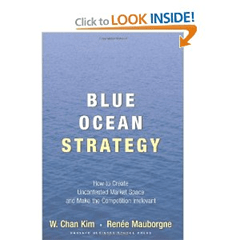
Blue Ocean Strategy

In their book, Blue Ocean Strategy: How to Create Uncontested Market Space and Make the Competition Irrelevant, W. Chan Kim and Renee Mauborgne outline a strategy process to create a long-term sustainable competitive advantage.

While a bit too full of consulting speak (as you can see from my notes), it is an excellent and useful book to help you think through your strategy. Especially today, companies need to be more than just another competitor in a mature and over-saturated market. Following the ideas in Blue Ocean Strategy will help you to find and exploit those customer and market niches where you can deliver unique value without all the competition. Continue reading

Posted in Growth and Strategy, Sales and Marketing | Tagged , , , | 1 Comment

It is Better to Be Good in Fact than Great in Fiction

This is my 100th blog post in my blog “Helping Leaders Win.”

If I had to sum up one line that describes my approach to business success and “winning leadership” over the previous 99 posts, it would be the title of this particular blog:

It is Better to Be Good in Fact than Great in Fiction.

The whole premise of my approach to “Helping Leaders Win” is to keep things simple, to focus on the fundamentals, and to just be good at what we do.

As a result, my advice and views are not cutting edge, business journal-worthy insights that will take business leaders and transform them into inspired mixes of George Washington, Napoleon, Gandhi, Jack Welch, and Steve Jobs.

The simple, but boring, truth is that we just need more of our leaders to be good leaders and more of our companies to be good, well-run companies.

Not great, good. Continue reading

Posted in Business Acumen, Leadership, Personal Success | Tagged , , , | 1 Comment

Ahead of the Curve: Two Years at Harvard Business School

In his book, Ahead of the Curve: Two Years at Harvard Business School, Philip Delves Broughton recounts his experience as a student at HBS. It is an interesting read, especially for those planning to go to business school. For our purposes, it is relevant for the insights about business and leadership that he shares from his own observations and from the experiences of leaders and notables that spoke at Harvard during Broughton’s two years. Continue reading

Posted in Business Acumen, Growth and Strategy, Perform / Execution | Tagged , , , | Leave a comment

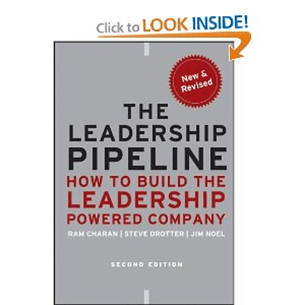
The Leadership Pipeline: How to Build the Leadership Powered Company

In their book, The Leadership Pipeline: How to Build the Leadership Powered Company, Ram Charan, Stephen Drotter, and James Noel lay out a model for building a pool of leadership talent at all levels of your business or corporation.

Introduction

  • There are Critical Career Passages (Transitions) in a Large Business Organization
    • Manage Self
    • Manage Others
    • Manage Managers
    • Functional Managers
    • Business Managers
    • Group Manager
    • Enterprise Manager
  • To navigate these passages, the leader needs to acquire a new way of managing and leading and leave the old ways behind
    • Skill requirements – what are the skills and abilities appropriate for the new position?
    • Time applications – what does the leader spend his or her time doing?
    • Work values – what does the leader believe is important and becomes the focus of effort? Continue reading
Posted in Leadership, Team / People | Tagged , , | Leave a comment

Business Turnaround 301 – Right People Doing the Right Job

In discussing business turnarounds, we have seen that the three fundamentals to turn a troubled business around are as follows:

  1. Understand Reality, Face Reality
  2. Focus, Prioritize, Plan (Less is More)
  3. Right People Doing the Right Job

Today, we turn our attention to the third fundamental: “Right People Doing the Right Job.” Continue reading

Posted in Improve / Turnaround, Perform / Execution | Tagged , , , , , , | 1 Comment

12 Stupid Hiring Mistakes to Avoid in 2012

Despite the 8.6% unemployment rate, many companies searching for their next manager or executive have but one complaint:

I cannot find the right person for my company; there is no good talent out there.

In reality, nearly all these companies are making one (or more) of twelve stupid hiring mistakes that all but guarantee they will not find the “A-Level” managers and executives that they need.

1.  Waiting

It is time to face reality. Your unmotivated “B” and “C” players will not suddenly become valued performers. Your operationally strong leaders are not going to become marketing, sales and growth focused any time soon. And your growth strategies will sputter without the new talent and “fresh eyes” to implement. Continue reading

Posted in Leadership, Team / People | Tagged , , , | 4 Comments

Made To Stick: Why Some Ideas Survive and Others Die

In their excellent book, Made to Stick: Why Some Ideas Survive and Others Die, Chip Heath and Dan Heath discuss the ways to make sure your ideas stick. An idea sticks when it is understood and remembered and has a lasting impact in changing your audience’s opinions or behaviors.


  • Simplicity
    • Find the Core
      • In a courtroom, if you argue ten points (even if each is a good point), when they get back to the jury room the jury won’t remember any.
      • Strip ideas to the core by relentlessly prioritizing (be a master of exclusion). Finding the core means stripping an idea down to its most critical essence. Continue reading
Posted in Business Acumen, Sales and Marketing | Tagged , , , | Leave a comment

How to ‘Do What You Say’ and Distinguish Yourself from Everyone Else

A fundamental for business relationships and business success is to do what you say you are going to do. ‘Doing what you’ say builds trust and confidence that you are reliable, dependable, and will live up to your commitments and promises.

Unfortunately, this fundamental is far more often preached than actually practiced. All of us are accustomed to other people and businesses not doing what they say and not living up to their promises.

So, how can each of us do what we say every time? Continue reading

Posted in Leadership, Personal Success | Tagged , , , | Leave a comment

Skills for Success: The Experts Show the Way

In Skills for Success: The Experts Show the Way, the Soundview Editorial Staff summarizes the keys to achieving success in business and life. It is an oldie (1988), but it is well worth reviewing even today, 23 years later.

  • How to Get the Most from Yourself
  • You can be successful
    • Common Sense – to reduce one’s understanding of a complex problem to the simplest terms. Continue reading
Posted in Leadership | Tagged , , , | Leave a comment

The Lessons of History and Great Leadership

I enjoy the Great Courses series produced by the Teaching Company. Each course is a series of lectures that I can listen to while working out or in the car. Currently, I am listening to a course entitled The Wisdom of History by Professor J. Rufus Fears at the University of Oklahoma.

The basis of the course is a series of 10 lessons or guideposts that we can learn from history. For our sakes, four of these lessons relate directly to business and business leadership.

1.  We do not learn from history and the consequences of this failure are tragic. Continue reading

Posted in Leadership | Tagged , , , | 1 Comment

Going Global – 3 Lessons From Those Who Failed

This is a guest blog by Mike Gomez (Global Success Centers and Allegro Consulting)

I recently gave a presentation to owners of American companies who were contemplating a global expansion strategy.  I decided to share some lessons I gleaned while working with foreign companies struggling to be successful here in America.  After all, learning from your mistakes is smart, learning from the mistakes of others is wise.

Here are my top three lessons from those who failed:

1.  Exporting or Global Expansion Should be Part of an Overall Strategic Plan and Not Simply Done on a Whim

“Why are you choosing to go global?”  “Why now?” Continue reading

Posted in Growth and Strategy | Tagged , , | Leave a comment

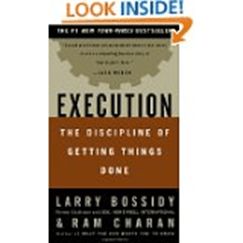
Execution: The Discipline of Getting Things Done

In their book, Execution: The Discipline of Getting Things Done, Larry Bossidy, Ram Charan and Charles Burck drive home the point that execution is vital.

The difference between a company and its competitors is its ability to execute; that is the critical difference for success.

In their view, execution is not tactics; it is a discipline and a system that has to be built into the company’s strategy, its goals and its culture. Strategies most often fail because they are not executed well; things that are supposed to happen do not happen. The crucial gap in business is the gap between what a company’s leaders want to achieve and the ability of the organization to achieve it. Continue reading

Posted in Business Acumen, Perform / Execution | Tagged , , , , | 1 Comment

The 9 Biggest Time Wasters in Business

The sheer waste of time in the typical business today is incomprehensible. From half-baked initiatives and pet projects that lead nowhere to endless and endlessly dull meetings, the typical employee can fritter away as much as half of his or her day doing nothing of consequence and nothing that moves the business forward.

We know what most of these time wasters are. They have been the same for years.

Why then are we so incapable of rooting them out?

The Challenge

The difficulty in rooting out time wasting activities in most businesses is that these tasks, done in moderation, are important, even vital, to the functioning of the business. Continue reading

Posted in Business Acumen, Perform / Execution | Tagged , , , , | 1 Comment

The New Leader’s 100 Day Action Plan

In their book, The New Leader’s 100 Day Action Plan: How to Take Charge, Build Your Team, and Get Immediate Results, George B. Bradt, Jayme A. Check and Jorge E. Pedraza discuss leadership transitions and on-boarding.

Executive Summary

  • High performance teams and organizations are built of people, plans, and practices aligned around a shared purpose
  • Tactical capacity bridges the gap between strategy and execution, ensuring that a good strategy doesn’t fail because of bad execution
  • Five building blocks underpin a team’s tactical capacity
Posted in Leadership, Team / People | Tagged , , , | Leave a comment

Human Resources – MIA, But Needed Now More Than Ever

For years, Jack Welch (former CEO of GE) has pleaded that human resources is one of the most important functions in any corporation. Alas, the reality in most companies today is that human resources (HR) people do not have a seat at the corporate table when most important decisions are made.

The downturn has exacerbated this trend as companies have focused their efforts on the critical functions of operations and sales and all but eliminated their people-centric thinking. Continue reading

Posted in Team / People | Tagged , , | Leave a comment

Leading at a Higher Level

In this book, Leading at a Higher Level: Blanchard on Leadership and Creating High Performing Organizations, Ken Blanchard summarizes his thoughts on leadership and building winning teams and winning businesses.

  • Set your sights on the right target and vision
    • Is your organization high performing?
    • Is it a visionary organization that endures beyond any one leader?
    • The power of vision
      • The best way to predict your future is to create it
      • The vision provides guidance for daily decisions so that people are aiming at the right target, not working at cross-purposes with each other
    • Focus on 3 – 4 values that really impact behavior Continue reading
Posted in Leadership | Tagged , , , , | 1 Comment

5 Business Fundamentals I Did Not Learn at Wharton

In a previous blog, I discussed the five business fundamentals that I learned at Wharton. Today, I discuss five keys to business success that I did not learn at Wharton (and that may not be learnable in a classroom environment).

1.  Politics matters

One key to business success is to do business with the right people, people who are ethical and will deliver. As such, people usually prefer to do business and work with people that they know and are comfortable with. An unknown with incredible talent does not stand a chance against a mediocre that is known and politically linked in. Continue reading

Posted in Business Acumen, Leadership | Tagged , , , | Leave a comment

It’s Your Ship – Management Techniques from the Best Damn Ship in the Navy

In this book, former Navy Captain D. Michael Abrashoff boils down the management and leadership techniques that helped his ship, the Benfold, become “the best damn ship in the Navy.” His 11 fundamentals are equally applicable in the business world.

1.  Take Command

  • How can I ensure that my eventual departure won’t be met with relief?
  • Will I be, or am I now respected, trusted, and effective?
  • Are there better ways to do the things we do?
  • Do I hold myself accountable for my team’s performance?
  • Can we become the best damn ship in the Navy? Continue reading
Posted in Leadership | Tagged , , , , , , | 2 Comments