As leaders we are bedeviled by the Curse of Knowledge:
The Curse of Knowledge is the difficulty we have in imagining that another person does not know what we know.
The Curse of Knowledge rears its ugly head in three vital areas: communication, training, and sales.
Why are We Cursed?
Leaders are cursed because of the high level of our knowledge. We usually have deep and specific knowledge and insight that has been honed over years of learning and experience. Many complicated issues related to our business seem simple and easy to us because we know these issues so well. As such, we cannot relate or understand when someone does not understand what to us is obvious.
Combatting the Curse
To combat our curse of knowledge, we need to do a better job when communicating, training and selling by keeping the following in mind:
![]()
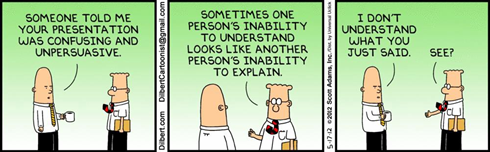
Know That We Are Cursed: We need to be aware that we are the experts and that others do not have the level of understanding that we have. In the cartoon, Dilbert clearly does not have that awareness; he blames the other person for their inability to understand rather than looking critically at his inability to explain.
Know the audience: We need to know the capability of our audience and communicate in a way and at a level that the audience would understand. In sales, we need to avoid the mistake that too many salespeople make in assuming that our customers understand our products and services. Our customers are experts on their life or their business; they are not experts on our products or services.
Keep It Simple and Short: The simpler that we can make our communication the better. As non-experts, our audience will have limited understanding and may have limited interest in what we are communicating. So we need to be attentive to the limits of their attention span and their limits in understanding more than a few key points.
Use Understandable Language: We need to avoid technical language, jargon, abbreviations, and complex words in order to communicate clearly.
Plan Ahead: Whether communicating orally or in writing, we need to plan ahead to organize the material in a way that is simple and easy for a non-expert to make connections with and understand.
Edit and Revise: We need to continuously improve our communication to ensure that we are understood. This starts with critiquing and editing our own work: if the communication is written, we should go back after some time and re-read (aloud if at all possible) to ensure that our writing is clear; if the communication is oral, we should reflect and critique our presentation and improve.
Get Feedback: We should get second opinions on our work. For written work, this involves having another person read what we have written. In a presentation or selling situation, we get feedback by reading the body language of the audience or asking questions to ensure that we have been understood.
Conclusion
The Curse of Knowledge muddies the waters and prevents us from communicating effectively; our written messages, our training, our sales presentations are not easily understood and are thus less effective. Through combatting the Curse of Knowledge, our communication will become clear and understood. And, as Marcus Buckingham writes, being clear is fundamental to being an effective leader:
Effective leaders don’t have to be passionate. They don’t have to be charming. They don’t have to be brilliant…They don’t have to be great speakers. What they must be is clear.






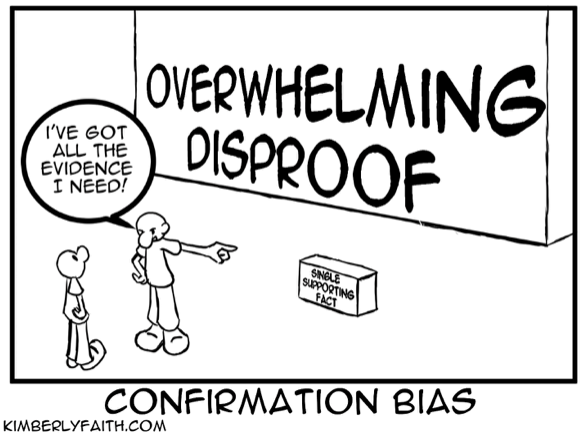 The biggest decision-making bias for all of us is the confirmation bias.
 The IT project took twice as long as planned. The construction project to expand the plant went over budget.
 “Predictions are difficult – especially about the future.”
 When continuous improvement is a fundamental part of our company culture, our business gets better every day and will soon out-run and out-perform the competition. Over 100 years ago, Henry Ford wrote:
 As I write this blog, we are in the midst of the Covid-19 Pandemic. Each day brings changes to how and where we can conduct business; we have little visibility into what the next month, three months, or six months will bring; and many of our employees are fearful.
 The consultant, Stan Sipes, once commented:
 “There are smart decisions and wise decisions. And one form of wisdom is the ability to judge when to let luck disrupt our plans. Not all time in life is equal. The question is, when the unequal moment comes, do we recognize it, or just let it slip? Jim Collins (Great by Choice)
 Successful leaders make good decisions… consistently.
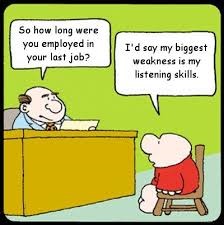 “It’s not always what we say; often it’s what we allow the other person to say. By listening, we gain trust and make other people feel more comfortable with us.” Rick Pitino
 Strategic thinking skills differentiate middle-level managers from effective upper level leaders. With excellent strategic thinking skills, the leader is able to make effective decisions that benefit their companies in both the short and long term.
 Hawaiians and other Polynesians are the descendants of peoples who traveled by boat from East Asia to settle their islands. Those most likely to survive the long and arduous journey were those with “thrifty genes”. They were those ancestors who were best able to process and use the limited food on their boat trips. Today, in a world of cheap and plentiful food, these same “thrifty genes” have led to an epidemic of obesity and diabetes among their descendants. What worked in one time may not work in another.
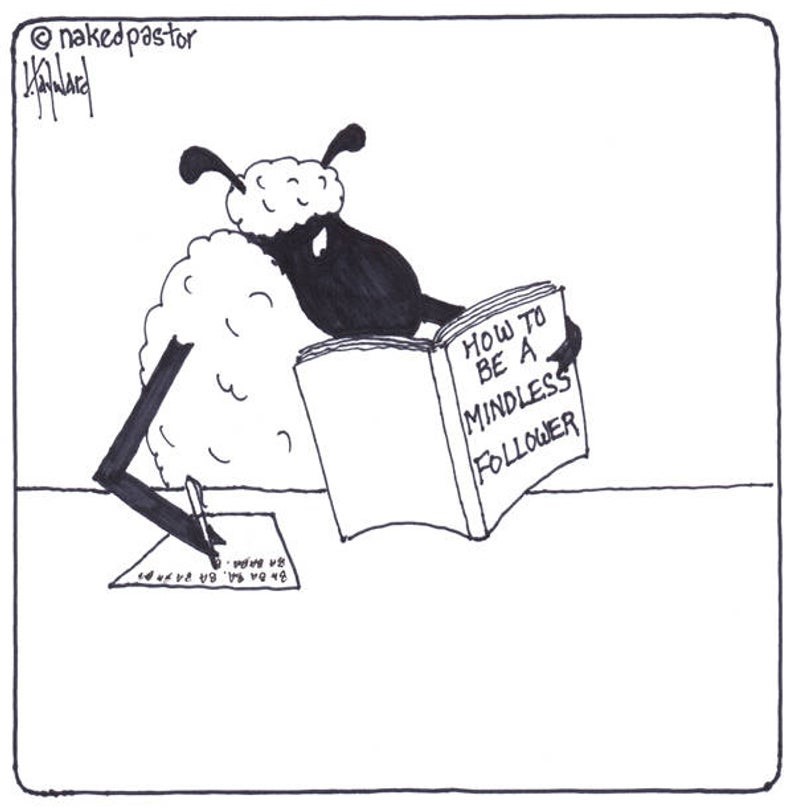 Even as leaders, we all have bosses. Perhaps, it is a Vice-President. Perhaps, it is the CEO. Perhaps, it is the Board of Directors.
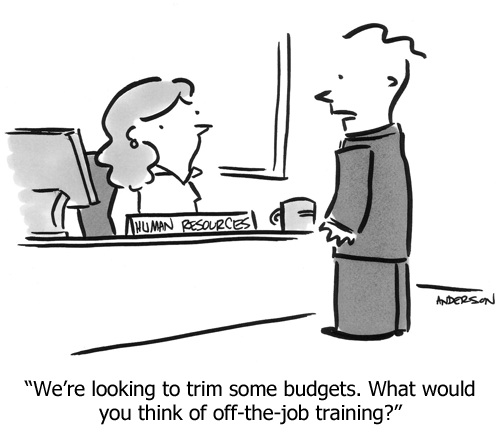 In corporate America, approximately $100 billion is spent each year on training. Yet, many studies show that training is only 10% – 15% effective. As Harvard Business School Professor Michael Beer writes, this is…
 David M. Shedd - Move Your Company Forward