Find Someone Doing Something Right Every Day


Last time, we ended with a quote from the psychologist William James: “The deepest human need is the need to be appreciated.”

As the leader of your company or business unit, one of your key roles is to build a winning team. An important part of any winning team is recognition and respect. Everyone on the team must feel that they are appreciated for what they do and thanked for doing a good job. In short, people need to be recognized.

Three questions spring to mind:

  1. Why give recognition?
  2. How to give recognition?
  3. How to get started giving recognition?


Why Give Recognition?

  1. Giving recognition builds the self-confidence and self-esteem of others on your team
    1. Even if you don’t personally need to be recognized, most people do appreciate being recognized for the hard and good work that they are doing
    2. There is ample research that people with more confidence in their job are more highly motivated and produce better work


  2. Giving recognition creates a winning team atmosphere
    1. Recognition is a positive in a world where we spend far too much time focusing on the negative
      1. Think of winning teams in sports and the positive feedback and support you see them giving each other (high fives to the field goal kicker after he makes the field goal, etc.)
      2. Think of losing teams in sports and the negativity and lack of team spirit and appreciation of one another that is most often visible
      3. Which culture do you want to foster?
    2. Recognition helps conquer the typical friction points in a company
      1. Friction points abound in companies
        1. Sales v. Marketing
        2. Production v. Engineering
        3. Sales v. Production
        4. Staff v. Line
        5. Corporate v. Field
      2. Recognize and be appreciative of the team members on “the other side” and you will almost certainly see them be willing to go an extra mile to help you out
      3. Two true examples:
        1. As a salesperson, “Joe” is always demanding of engineering and production. When they deliver on his requests, Joe says nothing telling everybody that it is about time that they did what they were supposed to do. When they miss a deadline, Joe immediately complains to everyone and demands action.
        2. Also in sales, Ben is always appreciative of engineering and production. He often comments and recognizes them for their good quality and responsiveness in sales reports and staff meetings. When they miss a deadline, Ben is demanding but respectful. He tells them that he is disappointed, but he speaks with them directly.
        3. Whose engineering and production requests always seem to go to the top of the pile? Whose requests always seem to go to the bottom of the pile? Who would you want on your team?


  3. Recognition allows for candor and honesty
    1. When recognition is genuine, critiques (discussed later and separately) are more likely to be heard
      1. Ben’s critiques when engineering or production make mistakes or miss a deadline are heard loud and clear and responded to
      2. Joe’s critiques are inevitably ignored
    2. As a leader, without positive encouragement and feedback, you are likely to be perceived as a “pigeon manager”
      1. Fly in with the white shirt. S**t on everyone. Fly back out.
      2. Pigeon managers are usually ignored
        1. Since everything is always negative, nothing that they say is perceived as being constructive
        2. Where is the motivation for the employees? The pigeon manager does not like or recognize anything. So, why bother?


How To Give Recognition?

  1. Criticize in private… recognize in private
    1. Group recognition means little to the individual
      1. “Thank you team. You have all done a wonderful job. Good work.”
      2. As an individual, what does such a statement really mean to you?
    2. With individual recognition in front of a group, those not being recognized feel slighted
      1. “I would like to recognize Jane for her great work on this project.”
      2. Kevin, Susan, and John, the other project managers who also do good work, are thinking: “What am I? Chopped liver.”
    3. One exception may be when you are using recognition to build the culture of the whole group
      1. Accountability
      2. Customer service
      3. Safety
  2. To give recognition
    1. Identify an opportunity for giving recognition
    2. Describe the behavior as immediately and as specifically as possible
    3. State how the behavior made a difference to you and to the organization and thank them for making that difference
    4. Best is to do face to face
      1. By following up in writing after the fact, the recognition will resonate
    5. Example:
      1. “Sarah, excellent job with resolving that customer’s problem. You were responsive throughout the process, zeroed in on the key issue, and put the problem to bed quickly. As you know a satisfied customer is the lifeblood of our business. So, thank you for creating another satisfied customer. Today, you helped to make our company a little bit better and a little bit stronger. Well Done!”
  3. Be direct and genuine
    1. Do not hem and haw
    2. Do not say the word “but”.
      1. If you “have to” offer a critique as well, wait and do it on another day.
      2. Otherwise, the critique will be heard and the recognition will be forgotten


How to Get Started Giving Recognition?

  1. Find someone doing something right every day
    1. Each day, create an action item for 20 minutes a day of MBWA time
      1. “Management by Walking Around”
      2. Interact with your team, thank them and give individuals recognition face to face when you see them doing something well
    2. Try the ten penny approach
      1. As you walk into the office every morning, put the ten pennies that are piled up on your computer keyboard into your left pocket
      2. Throughout the day, each time you give someone recognition or thank them for their work, move a penny from the left pocket to the right pocket
      3. At the end of the day, take all ten pennies that are now in your right pocket and pile up on your computer keyboard


  2. Some counter arguments shot down
    1. “I don’t need recognition. So why do these others need it?”
      1. You are not managing you.
      2. Do you really mean to say it means nothing (absolutely nothing) to you when your boss or spouse gives you a compliment about something that you did?
    2. “I try to do it. But, I just never get around to it.”
      1. See the bullet point above about finding someone doing something right every day
    3. “I have got a lot more important things on my mind.”
      1. Building and encouraging your team to be better is a pretty essential part of your job as a leader
    4. “Although the work was good, it could be better. I will recognize them when their work becomes perfect.”
      1. O.K., so they still need to improve more. Well, how do you get them to improve?
        1. By doing nothing?
        2. Or by encouraging and supporting them?
      2. “The worst recognition that I ever got was the recognition that I never got.”


  3. Just Do It!
    1. “You can never underestimate the power of simple recognition for a job well done.”
    2. It will brighten the day of the employees on your team
    3. It will brighten your day


“In the end, everybody wants recognition and respect.” Michael Bloomberg

Until Next Time.

Posted in Communication, Leadership, Team / People | Leave a comment

Lessons from Private Equity any Company Can Use (Orit Gadiesh and Hugh MacArthur)

Lessons from Private Equity Any Company Can Use


In the last few years, key Private Equity players have shifted their focus from financial engineering toward creating operating value. They are creating operating value in a systematic and focused way. As such, they are making their companies more valuable, which is the most important task of a leader.


The most important lessons from Private Equity are:

  1. Define the full potential
  2. Develop the blueprint
  3. Accelerate the performance
  4. Harness the talent
  5. Make equity sweat
  6. Foster a results-oriented mind set


  1. Define the full potential
    1. Rigorously ask and factually answer the question: “by how much can I increase my company’s equity value?”
    2. Define Full Potential
      1. Questioning
        1. Why would someone want to own this business?
        2. What can this business become?
      2. Analysis of data
        1. Demand analysis
          1. What are the true underlying drivers of demand? How are they changing? How will these drivers affect demand?
        2. Customer analysis
          1. What are this business’s customers going to do?
        3. Competitive analysis
          1. What are this business’s competitors doing and how does it stack up against this business?
        4. Environmental analysis
          1. Are there technological, regulatory or other issues or trends that may affect future performance positively or negatively?
        5. Microeconomic analysis
          1. How does this business really make money and where?
    3. Use the fact base to challenge “business as usual”
      1. Incremental moves to make current activities more profitable
      2. Aggressive moves that will reposition some or all activities for future success
      3. Shifting of resources away from those activities that don’t represent the future of the company
    4. A focus on the right critical issues (no more than 3 – 5) is crucial to achieving success
      1. While defining the critical issues and initiatives, define what the company will not do
    5. Adopt a 3 – 5 year time horizon for the plan to materialize
    6. Do a culture check
      1. Where is the momentum of the status quo coming from?
      2. How can this be changed?


  2. Develop the blueprint
    1. The blueprint is your roadmap for getting to that full potential
      1. Goal of what the full potential value can be in 3 – 5 years
      2. Who, what, when, where, and how
      3. Zero in on the few initiatives identified above
      4. Detailed and complete
      5. Focus on actions
      6. Start macro and then get to the actionable to do list
    2. Budget 2 – 6 months to get the blueprint process together with the goal to launch the first initiative within the first 100 days
    3. Create a change oriented atmosphere and alignment to the goals


  3. Accelerate Performance
    1. Mold the organization to the blueprint and match talent to the key initiatives
    2. Make someone own each initiative
    3. Monitor a few key metrics to show the progress toward operational goals before it shows up in the financial results
      1. Forward looking metrics
      2. As an example, consider sales
        1. A more forward looking metric is: how many new customer contacts?
        2. A more backward looking metric is: what are revenues per customer?
      3. Tailor metrics to each business
    4. Beware re-organizations
      1. Often, just a distraction
      2. Rarely do they solve the underlying issues
    5. Use rewards to motivate and align
      1. Pay employees for what you want them to do


  4. Harness the talent
    1. Get great people and get them to think like owners
      1. “At cause” attitude (focus on rooting out and then resolving the root cause, rather than dealing with the effect)
      2. Leaders with the drive and the ability to make investments succeed
    2. Have the right incentives to recruit, retain, and motivate these talented folks
      1. Create the right culture
      2. Create an atmosphere that allows people to do the right thing by shareholders and to reap their just rewards
        1. Share equity with key people
        2. Reward boldness and success
    3. Assemble a “value-added” board
      1. Draw on their expertise
      2. Find ways to get the board to ask critical questions sooner


  5. Make Equity Sweat
    1. Leverage the business for cash generation and balance sheet discipline
      1. Aggressively manage down working capital
      2. Capital expenditures
        1. CEO’s to play active role in capital allocation
        2. Manage capital expenditures depending upon whether maintenance or growth component
      3. Dispose of unproductive equipment / facilities
      4. Dispose of businesses / division that are underperforming
    2. Invest capital with discipline
      1. Subject additional investments (follow-on acquisitions, growth capital expenditures, etc.) to high hurdles
      2. Will this new acquisition or this growth capital expenditure really result in significant financial returns?


  6. Foster a results-oriented mind-set
    1. The culture that needs to be developed has the right managers with a bias for questioning the status quo, getting the facts, ferreting out the root cause, and taking action
    2. Powerful focus on earnings and cash
    3. Develop a repeatable formula: repeatable within one activity and also across multiple activities
    4. Push accountability down to its most effective level
      1. General managers and all lines of leadership need to feel that they are on the hook to deliver results
    5. As a leader in an organization, you must communicate communicate communicate
      1. Explain the full potential of the business and the goal
      2. Articulate why there needs to be change
      3. Persuade the team that the changes to be done are needed to reach goals
    6. Set the right example
    7. Continued commitment to “reset the hurdles” to maintain focus
Posted in Business Acumen, Leadership | Leave a comment

The Beatings Will Stop Once Morale Improves!


In countless workforce surveys, employee morale and employee loyalty are at record lows. According to these surveys, a large majority of employees will, at the first opportunity, go out and find another job, gleefully leaving their current “@!$#*%* employers”.

With the long recession, many employers have resorted to salary cuts or freezes and cuts in benefits. Due to lay-offs, the remaining employees are doing the same amount of work with fewer people. As a result, many employees are now working harder than ever for less money than they made a few years ago.

One result is plummeting morale.

As the leader of your company or business unit, what can you do to improve morale if you are not yet able (or allowed) to satisfactorily raise salaries and wages?

  1. Be Visibly Cost – Conscious
  2. Stop the Beatings
  3. Use the Leadership Tools At Your Disposal


Be Visibly Cost-Conscious

Most likely, the salary cuts and freezes were justified as necessary cost savings measures in extraordinary times. They were described as measures that were very painful for everyone; but, measures that just had to be done for the good of the business.

But, let’s face reality. As leaders, most of you cannot understand and feel the pain of your average employee during these hard times. Most likely, you have some money saved up and are not living paycheck to paycheck. Most likely, you have a good sense of the business plan so you have some amount of job security and some sense of control over the future. Most likely, you have a good network and transferrable skills so you have some confidence that you can find a job if you were to get laid off.

You may not be able to empathize fully with your employees. But, you need to ensure that they see and understand that everyone from top to bottom is in it together. For you, your leadership team and your staff that means that all need to cut back and be visibly more cost-conscious. Your example is evidence of your leadership.

Some obvious areas to consider:

  1. Be modest in your travels
    1. Limit to essential travel
    2. No Four Seasons hotels
    3. Rent a standard car
    4. Modest dinners
  2. Avoid too many lunches and lunch meetings on the company; brown bag it every once in a while
  3. Tone down off-sites or big company meetings or avoid all together if appropriate
  4. Unless absolutely necessary, avoid hiring additional staff, especially corporate staff
  5. Unless necessary, avoid hiring consultants
    1. If consultants are hired, remind them to be modest in their expenses and behaviors

An anecdote of what to avoid:

In the early 1990’s, one of the businesses that I later led was struggling. Wages had been cut. Headcount and costs had been slashed across the board. A top corporate staff person was brought in to find ways to cut costs even more. He led a number of meetings during his visit contributing cost-saving suggestions and advice. In the last meeting, he had to leave early. He had to rush to the airport to catch his Concorde flight to Europe.

Ouchhh!!!

“He that gives good advice builds with one hand. He that gives good counsel and example builds with both. But he that gives good guidance and bad example builds with one hand and pulls down with the other.” Francis Bacon

Stop the Beatings

It is easy to blame wage freezes and benefit cuts as the sole cause of your unhappy employees. But, that is rarely the case. The other, significant root cause for plummeting morale is the company’s leadership during these difficult times. So, change how you lead the company.

First, stop being petty. If you have taken away privileges or cut the small things that just take away from employees without really saving significant money, stop it. Pay for the coffee service. Take an employee out for lunch on his or her birthday. Keep the tradition of Thanksgiving turkeys. Get someone to cut the grass or clean the office instead of having employees do it. Celebrate a big win with snacks and drinks.

Second, stop adding more work to everyone’s plate. Better yet, take some work off their plate. At least 20 – 30% of the work that your over-worked employees are doing is adding little to no value. Take it away from them. Free them up. Let them breath. Let them be able to focus and do the good job that they want to do. A former boss of mine, Jim Schack, used to say: “It is not what you add to a troubled situation. It is what you take away.” By taking work away, prioritizing, and increasing focus, you may also find that your company becomes even more efficient.

Finally, be nice. Yes, you are under stress to perform. But, do not take it out on your team. Treat your team with respect. It will work wonders. In his book, It’s Your Ship, US Navy Captain D. Michael Abrashoff relates a study of reasons why sailors in the US Navy were unhappy and did not re-enlist. The number one reason was “not being treated with respect or dignity.”

Use the Leadership Tools at Your Disposal

Quiz Time: Please place these 10 items in order from most to least important for the average employee:

  1. Good wages
  2. Interesting work
  3. Promotional growth in the organization
  4. Job Security
  5. Good working conditions
  6. Personal loyalty to employees
  7. Full appreciation of the work done
  8. Sympathetic help on personnel problems
  9. Tactful discipline
  10. Feeling of being in on things


No peeking at the answers. J

OK, are you done?

According to numerous surveys over the years, the order from most to least important for the average employee is as follows:

  1. Full appreciation of the work done
  2. Feeling of being in on things
  3. Sympathetic help on personnel problems
  4. Job Security
  5. Good wages
  6. Interesting work
  7. Promotional growth in the organization
  8. Personal loyalty to employees
  9. Good working conditions
  10. Tactful discipline

Of course, you can quibble and debate about the order and the merit of any survey. But, that is not the point.

This is the point. You cannot promise job security; you may not be able to offer your employees a satisfactory raise in wages; and you should not guarantee personal loyalty. Nevertheless, you still have a lot of leadership and management tools at your disposal to improve the satisfaction and productivity of the employees on your team.

Use these tools and improve your employees’ morale. Use these tools and make your team a winning team. Use these tools and be a better leader.

To get you started, I leave you with a quote from the psychologist William James:

“The deepest human need is the need to be appreciated.”


Next Time:  “Find Someone Doing Something Right Every Day”

Posted in Leadership, Team / People | Leave a comment

Raving Fans (Kenneth Blanchard and Sheldon M. Bowles)

Raving Fans: A Revolutionary Approach to Customer Service

 Raving Fans: A Revolutionary Approach To Customer Service

  1. Successful organizations have one common central focus: customers
    1. Goods are not sold by companies
    2. Products are bought by customers
    3. As IBM used to advise its salespeople, “stop selling what you have and start selling what the customer wants.”
  2. Customers are often only satisfied because their expectations are so low and because no one else is doing any better. Perhaps, the customer service slogan should be:
    1. “No Worse than the Competition”
  3. First, decide what you want
    1. Create a vision of perfection centered on the customer
    2. Focus on when the customer is using your product
  4. Second, discover what the customer wants
    1. Discover the customer’s vision of what they really want and then alter your vision if need be
    2. However, your vision is the starting point
      1. Unless you have your own vision, how can you understand the customer’s vision?
      2. When you find out what the customer really wants, it will likely focus on just one or two things. Your own vision has to fill in the gaps
      3. You have to know when to ignore what the customer wants, and, if necessary, tell the customer to take his vision elsewhere to be fulfilled
      4. “Customers may pay our bills. But, they will never pick our people or set our vision and strategies.” Jeff Immelt (GE)
    3. Good customer service is looking after the whim of the customer, but only those whims that are defined in your particular customer service product
    4. Listen to customers
      1. Especially when they say one thing, but mean another
      2. Some complainers should be told that what they want is not part of the company’s customer service package
      3. Don’t forget internal customers; the next person in the chain to get their work
  5. Third, Deliver Plus One
    1. Deliver the vision plus one percent
    2. Consistency is critical as it creates credibility and shows integrity
      1. Creating a customer relationship is fragile
        1. Customers have been burned before and don’t trust easily
        2. They are watching to see you slip up
      2. Consistency will overcome their resistance
    3. To start, don’t offer too much service
      1. Limit the number of areas where you can make a difference
        1. It allows you to be consistent
      2. You will be further ahead doing very well on one thing rather than introducing a whole string of customer service goals all at once that cannot be executed upon
      3. In short, do not put the hurdle too high to start with and don’t raise the hurdle until you can consistently deliver on what you have already done
      4. The end goal is to promise more and deliver more; just don’t promise too much at once
    4. To help deliver, create systems
      1. Systems give you a floor, not a ceiling
      2. Systems create a minimum standard of performance consistently. If you fall short, you have cheated the customer
    5. The rule of One Percent
      1. Improve one percent each week; by year end you are ahead by 50%
      2. Continuous improvement
      3. Also, a continuous one percent improvement gives you flexibility to change gears, alter your course, and re-adjust if needed on what is delivered. But, it all must be delivered consistently
  6. In the end, good customer service is about giving the customer a symbolic hug
Posted in Growth and Strategy, Sales and Marketing | Leave a comment

Business Turnaround 201 – Focus

In the blog, “Business Turnaround 101 – Let’s Be Honest,” we saw that the three fundamentals to turn a troubled business around are as follows:

  1. Understand Reality, Face Reality
  2. Focus, Prioritize, Plan (Less is More)
  3. Right People Doing the Right Job

We also reviewed “Understand Reality, Face Reality.”

Today, we turn our attention to “Focus, Prioritize, Plan (Less is More).” Continue reading

Posted in Improve / Turnaround, Perform / Execution | 3 Comments

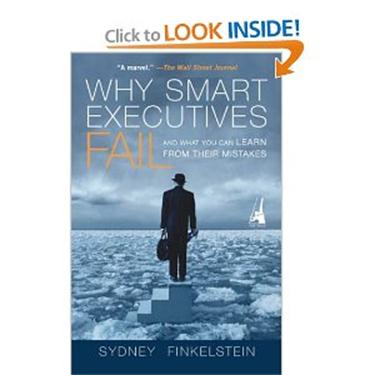
Why Smart Executives Fail (Sydney Finkelstein)


  1. The “standard” causes of failure do not explain why smart executives fail
    1. “The executives were stupid.”
    2. “The executives could not have known what was coming.”
    3. Etc.
  2. New ventures often fail spectacularly
    1. Do not lose sight of what counts in any business venture
      1. Strategy
      2. Capability
      3. Customers
      4. Competitive advantage
  3. Innovation and change can cause failure
    1. Many companies choose not to cope with the change. They simply ignore it.
    2. Executives must motivate awareness and facilitate action within their companies in response to change
  4. Mergers and Acquisitions can cause failure
    1. The search for synergy and the quest for integration are key areas where failure can take place
    2. Challenges in companies related to mergers
      1. Hubris (pride)
      2. Integration
      3. Cultural roadblocks
  5. Strategy Gone Bad: Doing the wrong things can cause failure
    1. Why strategists misread competition and select irrational strategies
    2. Beware of people blinded by hubris and/or desperation
  6. The Causes of Failure
    1. Brilliantly fulfilling the wrong vision
    2. Delusions of a dream company – how executives avoid facing reality
      1. Does your company systematically exclude any information that could contradict its reigning picture of reality
    3. Tracking down the lost signals
      1. Why businesses don’t act on vital information
    4. Seven habits of spectacularly unsuccessful people – the personal qualities of leaders who preside over major business failures
      1. They see themselves and their companies as dominating their environments
      2. They identify so completely with the company that there is no clear boundary between their personal interests and their corporation’s interests
      3. They think that they have all the answers
      4. They ruthlessly eliminate anyone who isn’t 100% behind them
      5. They are consummate company spokespersons, obsessed with the company image
      6. They underestimate major obstacles
      7. They stubbornly rely on what worked for them in the past
  7. Learn from Mistakes
    1. Predict the future – look for the early warning signs
      1. Unnecessary complexity
      2. Speeding out of control
      3. The distracted CEO heavily involved in activities outside the company
      4. Excessive hype about the company and especially about the CEO
      5. A question of character (ethics and defensiveness)
    2. Living and surviving in a world of mistakes
      1. Step up to learning and open mindedness
      2. Listen to people; learn from people
      3. Share worst practices, not just best practices
        1. Why did something fail and how can we learn from this failure?
      4. Spread the news
        1. Active communication within the company and with stakeholders
Posted in Business Acumen, Leadership | Leave a comment

Business Turnaround 101 – Let’s Be Honest

“My business is in trouble. We are losing money. Customers are not buying. Morale is low. And we cannot seem to do anything right.”

What then must be done? You have to turn around your business. But, how?

On this question, I may even know what I am talking about as I have been involved in successful turnarounds at three different money-losing companies.

As always, I start with my three keys. The three keys to turn a troubled business around:

  1. Understand Reality, Face Reality
  2. Focus, Prioritize, Plan (Less is More)
  3. Right People Doing the Right Job Continue reading
Posted in Improve / Turnaround, Leadership | 1 Comment

Winning (Jack Welch)

Jack Welch’s best seller Winning gives the renowned GE CEO’s view on what business leadership is all about. As excerpted from the book and from a subsequent article in Business Week (www.businessweek.com), I give a summary of the business leadership advice that Jack Welch offers in Winning.

  1. Leaders are always upgrading their team, using every opportunity possible to evaluate, coach and build self confidence
    1. Continue to inject self-confidence into those who have earned it
    2. Praise often, the more specific the better
    3. Build the team with the 4-E and 1-P framework
      1. Energy that is positive
      2. Ability to energize others
      3. Edge (courage for tough decisions)
      4. Execute (ability to get the job done)
      5. Passion (juice for life in their veins)
  2. Leaders make sure people not only see the vision, they live and breathe it
    1. “There were times I talked about the company’s direction so much that I was completely sick of hearing it myself”
  3. Leaders get under everyone’s skin with optimism and positive energy
    1. A happy tribe increase your chance of winning significantly
  4. Leaders establish trust with candor, transparency, and credit
    1. The dirty little secret in business is lack of candor; no one is being really honest with one another, blocking
      1. Good ideas
      2. Quick action
      3. Your good people contributing all that they have
    2. Leaders accept the blame and always share the credit
  5. Leaders have the courage to make unpopular decisions and tough calls
  6. Leaders are always asking why?
    1. They have a deep desire to make sure their questions are answered with action
    2. “We will look into it” means nothing to a good leader
  7. Leaders inspire risk taking and learning by setting the example
  8. Leaders celebrate
    1. Celebrating make people feel like winners
    2. It is fun
Posted in Business Acumen, Leadership | Leave a comment

Change – A Broad Overview


Read the business magazines or the Wall Street Journal and change is, as always, a hot topic:

  1. “The world is changing faster than ever, so you have to change faster or you will become a dinosaur.”
  2. “People hate change. Yet, knowing how to change is the single most important skill in business today.”

 WOW!! Scary stuff.
 

As we all know, these quotes have a kernel of truth in them. Change is omnipresent. But, if we keep it simple, we can learn how to change and improve our businesses. The purpose of this blog is to give a broad overview of change. Hopefully, you will pick up some basic thoughts and ideas on change that you find useful.

So, let’s get started.

Why Do We Need to Change?

The purpose of change in a business is to either maintain or improve your business’s competitive position. In short, if change does not lead to improvement, then it is just wasted effort.

Looking at the history of science, Steven Goldman said: “in history, it is self-evident that progress results from a change. But, change does not necessarily equate with progress.” I repeat. “Change does not necessarily equate with progress.” You want to change only if it will help maintain or improve your competitive position.

What Causes Change?

Change results from two forces:

  1. External events
    1. Changes in the marketplace
    2. Changes with competitors
    3. Changes in technology
  2. Internal events
    1. Personnel changes
    2. Identified inefficiencies or weaknesses


What are the Types of Change?

There are three types of change:

  1. Incremental change
    1. Commonly known as continuous improvement, these are the daily improvements and efficiencies in doing tasks and doing business that (hopefully) each of your employees is working on daily.
    2. Probably the most important type of change for making your business successful
      1. As an example, just think if every day people on your team could do their jobs just 1% better. After 70 days, that 1% would have accumulated to a doubling in efficiency with a further doubling every 70 days.
    3. Primarily done in the context of production
      1. Toyota and its lauded kaizen method
    4. In other areas of the business, incremental change is often not sexy enough
      1. It is hard to measure
      2. Requires real managing and valuing the contributions of everyone on the team
  2. Step change
    1. Commonly known as change initiatives or change programs, these are the “big” initiatives and programs rolled-out to make the business significantly better
    2. Very sexy
      1. Usually high profile and led from the top, these initiatives are classified as the “solution” to the business problem
      2. Since sexy, these initiatives seem to breed like rabbits with some companies having as many as 25 active change initiatives on-going at the same time. See the article “The Acceleration Trap” for a more complete discussion (http://hbr.org/2010/04/the-acceleration-trap/ar/1) of the over-breeding of change initiatives and its effect on businesses.
    3. Usually, unsuccessful and exhausting
      1. Nearly all studies report that 70% – 80% of all major change initiatives do not reach their originally stated goal or are abandoned before completion.
      2. Require a large amount of individual and corporate energy to get the initiatives moving forward.
      3. As with new government programs, change initiatives take on a long life of their own as they have the backing of top management who have a vested interest in seeing an initiative that they have developed and promoted be perceived as a success.
  3. Complete transformation
    1. This is a business turn-around or complete transformation of the company from one business model to another
    2. Requires a tremendous amount of energy and can become all-consuming; but, generally has a beginning and an end
    3. Difficult to do well
      1. Usually has two phases: stop bleeding and re-building. The challenge is that the skills to stop bleeding (cutting costs, improved efficiencies, etc.) are often different than the skills to re-build the business (sales and marketing, etc.)
      2. In order to succeed, requires a concerted effort to stop doing things that are no longer relevant. “Stop Doing” is one of the hardest things for any business to achieve.
      3. As a positive, business turn-arounds generally create a tremendous focus in the business


What Are the Biggest Mistakes Businesses Make When Undertaking Change?

  1. Change too much
  2. Change the wrong thing
  3. Skip bases


Change Too Much

Businesses usually undertake too many changes for several reasons.

First, they over-estimate the capacity of an organization to change. In looking at the business and the competitive landscape, top management often realizes that there are many areas to improve. While it is true that each one of these areas needs to be improved, people do not have the attention and perception span and the time to improve all these areas at the same time (while focusing on their “real jobs”). By default, too many priorities become no priority.

Second, top management and their staff pride themselves on their bias for action. So, they introduce changes and initiatives to make it happen. For staff people, “high potentials” who are rotated through jobs every few years, or people in middle layers in a bureaucracy, these initiatives become justifications for the importance of their job. Further, top management may not realize that the time it spends on any one initiative is multiplied several times over as the initiatives extend down into the trenches.

Third, poor management and poor execution is not dealt with directly. Instead, it can become a reason for a change or training initiative or program. A poor performance in sales may not require a “sales training” initiative. It may just require having better sales managers and holding them accountable.

To sum up, Jim Collins in his book How the Mighty Fall, reminds us: “if you want to reverse decline, be rigorous about what not to do.”

Change the Wrong Thing

An operational consultant friend of mine (schooled in Theory of Constraints, Lean, Six Sigma, Quality, etc.) relates a story. He was invited into a plant in central Pennsylvania to see what he could do to improve the operations further. The plant manager already had a number of initiatives under way and was genuinely open to new ideas. My friend was impressed; the plant was clean, well-laid out, and efficiently produced a quality product. Afterwards, he met with the President who was excited to know what more could be done to improve the plant.

My friend’s answer was quite simple. “Don’t do anything more in the plant. The plant runs very well. But, the most important thing that can be done to improve the business is to bring in more sales. Any tweaks and slight improvements in the plant would be minor compared to the improvements in the business with more sales.”

In this case, the overall constraint (what is holding the business back) is not the plant, it is sales. By improving the plant further, you make the plant better. But, that does not necessarily make the business better. It is great to have an excellent plant. But, the goal is not to have the best plant. The goal is to have the best overall business with the best competitive position.

This concept of “change the wrong thing” often occurs when management trained and promoted under one set of business conditions needs to respond to different business conditions. In the above story, the production focused President wanted to solve the company’s problems by focusing on what he knew best (production) instead of what was needed (additional sales). To a leader comfortable and confident in swinging a hammer, every problem will look like a nail.

Skip Bases

Baseball is reasonably simple. You get a hit. You run to first base. If it makes sense, then you run to second base. Then to third base. Then to home. You do not skip bases.

In change and change initiatives, people often skip bases. They try to go from the batter’s box to third directly without going to first and second. Most often, you will see this in change initiatives undertaken with the help of consultants, who are peddling a “solution.” This solution has to be reasonable complex or the company will not perceive that the consultant is adding any value. Unfortunately, the company may not be prepared for the solution that the consultant has to offer.

Let’s give an example. A company is struggling and realizes that it has a poor sales and marketing presence and team. The solution is to implement a CRM (Customer Relationship Management) program like Salesforce.com. With it, the sales team will all be able to track customers and customer activities better and everything will be great!!!

WRONG!!

Do not skip bases. As described, the company is barely out of the batter’s box on sales and marketing. Full implementation of a productive sales and marketing effort with Salesforce.com is third base. To even begin working on a CRM solution you need to be at second base. But, to get to second base, you need to, first, ensure that top management has a commitment to customer service and sales. Then, get decent sales management in place that will over-see and evaluate the sales team. Then, ensure that you have the right people on your sales team. Then, ensure that the team is properly trained on how to sell the product or service. Then, develop the discipline in the sales team to record their contacts in Microsoft Outlook and write sales reports. By this point, you may finally be ready to implement Salesforce.com or another CRM program.

What are the Three Keys in Undertaking Change?

Undertaking change and business turn-around are topics of future blogs. In these upcoming blogs, I will discuss the three keys for change as the following:

  1. Understand Reality, Face Reality
  2. Focus, Prioritize, Plan (Less is More)
  3. Right People Doing the Right Job


Until Next Time.

Posted in Business Acumen, Improve / Turnaround | 3 Comments

What Got You Here Won’t Get You There (Marshall Goldsmith)

This book by executive coach, Marshall Goldsmith, discusses the weaknesses in leadership behavior that eventually catch up with most leaders and lead to their downfall.


Use this list of weaknesses to evaluate your own behavior and those of your key people. Then, select the 1 – 2 most egregious weaknesses and manage yourself and your key people to each person’s weakness.

Weaknesses in Leadership Behavior

  1. Winning too much
    1. The need to win at all cost and in all situations – when it matters, when it does not , and when it is totally beside the point
  2. Adding too much value
    1. The overwhelming desire to add our two cents to every discussion
  3. Passing Judgment
    1. The need to rate others and impose our standards on them
  4. Making Destructive Comments
    1. The needless sarcasm and cutting remarks that we think make us sound sharp and witty
  5. Starting with “NO”, “BUT”, or “HOWEVER”
    1. The overuse of these qualifiers which secretly say to everyone, “I’m right. You’re wrong.”
  6. Telling the world how smart we are
    1. The need to show people we’re smarter than they think we are
  7. Speaking when Angry
    1. Using emotional volatility as a management tool
  8. Negativity
    1. The need to share our negative thoughts even when we were not asked
  9. Withholding Information
    1. The refusal to share information in order to maintain an advantage over others
  10. Failing to give proper recognition
    1. The inability to praise and reward
  11. Claiming Credit that we don’t deserve
    1. The most annoying way to overestimate our contribution to any success
  12. Making Excuses
    1. The need to reposition our annoying behavior as a permanent fixture so people excuse us for it
  13. Clinging to the past
    1. The need to deflect blame away from ourselves and onto events and people from our past; a subset of blaming everyone else
  14. Playing favorites
    1. Failing to see that we are treating someone unfairly
  15. Refusing to express regret
    1. The inability to take responsibility for our actions; admit that we are wrong, or recognize how our actions affect others
  16. Not Listening
    1. The most passive aggressive form of disrespect for colleagues
  17. Failing to express gratitude
    1. The most basic form of bad manners
  18. Punishing the messenger
    1. The misguided need to attack the innocent who are usually only trying to help us
  19. Passing the buck
    1. The need to blame everyone but ourselves
  20. An excessive need to be “me”
    1. Exalting our faults as virtues simply because they are who we are
  21. Goal Obsession
    1. Bridge on the River Kwai: Alec Guinness was so focused on building the bridge that he forgot the larger mission was winning the war


Other Thoughts and Ideas from the Book

  1. The sub-title to the book could be: “Stupid things top people do that they need to stop doing now!”
  2. The less we focus on ourselves and the more we consider our people the more it benefits us
  3. Stop acting as if you are managing you. This is the Golden Rule Fallacy. You are leading and managing people who are different from you and thus need to be managed differently than you would want to be managed.
  4. “Not Listening” is likely one of the most common weakness. Some suggestions on listening effectively:
    1. When listening before we speak we need to ask ourselves: “Is it Worth It?”
    2. Great listeners not only listen well they make the speaker feel like he or she is the only person in the room.
    3. In listening, eliminate any striving to impress the other person with how smart or funny you are. Don’t say “I knew that.” Don’t use the words “no”, “but”, “however.”
  5. Don’t kid yourself; your flaws at work do not vanish when you walk through your front door at home. Ask your spouse or children, they will be able to tell you your weaknesses in a New York minute.
Posted in Business Acumen, Leadership | 2 Comments

Quotes Relating to Winning at Business That I Just Like


Quotes on Decision Making and Problem Solving

  1. “A problem well stated is a problem well solved.” John Dewey (American Educator)
  2. “Life is the art of drawing sufficient conclusions from insufficient premises” Samuel Butler
  3. “Defining a problem is key to solving a problem. What you have to learn is that the other guy may have a different definition of the problem.” Alfredo Cristiani (President of El Salvador)
  4. “Managers should make a decision no later than you need it, but as late as possible, because you always have more information.” Peter Drucker
  5. “We cannot solve problems by using the same kind of thinking we had when we created them.” Albert Einstein


Other Quotes

  1. “Success or failure often depends on getting the fundamentals correct in an ambiguous world.” The Logic of Life.
  2. “Make it as simple as possible, but no simpler.” Albert Einstein
  3. “There seems to be some perverse human characteristic that likes to make easy things difficult.” Warren Buffett
  4. “Most of what we call management today consists of making it difficult for people to get their work done.” Peter Drucker
  5. “Be careful what you measure, you may get it – and it may kill you. Complete focus on a metric is likely to improve the metric, but not necessarily the business.” Michael Hammer
  6. “A system of bureaucratic rules subverts the ethics of freedom and responsibility that marks a culture of discipline.” Jim Collins
  7. “We would rather suffer the visible costs of a few bad decisions than incur the many invisible costs that come from decisions made too slowly – or not at all – because of a stifling bureaucracy.” Warren Buffett
  8. “Unless commitment is made, there are only promises and hopes; but no plans.” Peter F. Drucker
  9. “You will be surprised at how much you can get accomplished when you do not care who gets the credit” Ronald Reagan
  10. “Good management consists in showing average people how to do the work of superior people.” John D Rockefeller.
  11. “The difficulty lies not so much in developing new ideas as in escaping old ones.” Ken Blanchard
  12. “To a leader with only a hammer in his pocket, every problem looks like a nail”
  13. “We need to accept that we do not know what we do not know.” CEO, Yum Brands
  14. “No plan survives contact with the enemy.” Prussian Field Marshall Helmuth von Moltke
  15. “If you do not know where you are going any road will get you there.” Alice in Wonderland
  16. “Only when the tide goes out do you discover who’s been swimming naked.” Warren Buffett
  17. “Each corporate crisis is unique, though one thing they have in common is hubris (pride) that blinds the senior managers to changes in the marketplace.” Steve Miller (Turnaround Kid at Chrysler and Delphi Industries)
  18. “If you are failing at your job, figure out what your successor will do, and then do it before he is given the chance”. Gary Wendt Former CEO of GE Capital)
  19. “If you want to reverse decline, be rigorous about what not to do.” Jim Collins
  20. “I want generals who are really good and really lucky.” Napoleon
  21. “History never repeats itself. It only rhymes.” Mark Twain
  22. “The difference between try and triumph is a little oomph (umph).  If everyone gives a little extra oomph success is around the corner!” Holly Baker
Posted in Business Acumen, Leadership | Leave a comment

Quotes on Change

In some upcoming blogs, I will be discussing change and how to significantly change and improve your business. The three keys for change are the following:

  1. Understand Reality, Face Reality
  2. Focus, Prioritize, Plan (Less is More)
  3. Right People Doing the Right Job

To whet your appetite for my upcoming, and oh so scintillating blogs on change, I share with you now some of my favorite quotes on change and change initiatives.

Quotes on Change

  1. “In history, it is self-evident that progress results from a change. But, change does not necessarily equate with progress.” Steven L. Goldman (Historian of Science)
  2. “It is always easier to talk about change than to make it.” Alvin Toffler
  3. “The only thing you know for sure is that if you do nothing, then nothing will happen. Nothing will change.” Bill Watkins (CEO of Seagate Technology)
  4. “The three stages of reaction to a change or a new idea:” (Ronald Reagan)
    1. “It is crazy. It will never work. Don’t waste my time.”
    2. “It is possible, but it is not worth doing.”
    3. “I have always said it was a good idea. I am glad that I thought of it.”
  5. “One challenge in change is the River Kwai syndrome. In the movie The Bridge on the River Kwai, the colonel was so focused on maintaining the morale of his men by building the bridge that he forgot the more important issue was to win the war. To the leaders of a change initiative, the success of the change initiative can often become the goal in and of itself, not the success of the overall business.” David Shedd
  6. “Your transformation as a leader must come before you can transform your business. To lead a change you as the leader must have already changed.” Wayne Smith
  7. “Sometimes the most difficult act of leadership is not fighting the enemy; it’s telling yourself and your friends that it is time to change.” Bill Gates
  8. “We must become the change we seek.” Ghandi
  9. “Everyone thinks of changing the world, but no one thinks of changing himself.” Leo Tolstoy
  10. “How wonderful it is that nobody need wait a single moment before starting to improve the world.” Anne Frank
  11. “Only 30% of executive surveyed consider their change programs successful.” McKinsey and Company Survey
  12. “A change initiative can go wrong when the fix is determined by the experts and then rolled out to the whole system. This ignores people and their potential for contribution and engagement. So the answer is to go to one plant, do the work there, make it a star performer, and then apply it to other plants. Once one plant takes it on, and there is a dramatic improvement, people say ‘Wow, what did you do?’ Then the change initiative can be replicated throughout the whole system.” Adam Farber (Boston Consulting Group Partner specializing in Lean Initiatives)
  13. “The core of the matter is always about changing the behavior of people, and behavior change happens in highly successful situations mostly by speaking to people’s feelings… In highly successful change efforts, people find ways to help other see the problems or solutions in ways that influence emotions, not just thought. John Kotter and Dan Cohen, The Heart of Change
  14. “People often resent change when they have no involvement in how it should be implemented. So, contrary to popular belief, people do not resist change, they resist being controlled.” Ken Blanchard
  15. “Tell me, I may listen. Teach me, I may remember. Involve me, I will do.” Chinese Proverb
  16. Erik Fyrwald of Nalco was asked about his to do list as a change agent CEO coming in from outside:
    1. “I spent the first weeks and months listening a lot – to the leadership of Nalco, talking to people across the organization. I traveled a lot. Got out there with customers all over the world trying to understand what we do well, what we didn’t do well, where they saw opportunities. Spent time with my leadership team, getting their view on what we needed to do and also assessing the leadership and who we really needed, and what other capabilities we need to bring in.”
  17. “Success is a lousy teacher. It seduces smart people into thinking they cannot lose.” Bill Gates
  18. “Troubled companies are typically in denial and can’t understand why they’re in trouble and why they need to change.” Steve Miller
  19. “Most ailing organizations have developed a functional blindness to their own defects. They are not suffering because they cannot resolve their problems, but because they cannot see their problems.” Author John Gardner
  20. “He that is good with the hammer tends to think everything is a nail.” Abraham Maslow
  21. “In training camps, therefore, we don’t focus on the ultimate goal – getting to the Super Bowl. We establish a clear set of goals that are within immediate reach: we’re going to be a smart team; we’re going to be a well-conditioned team; we’re going to be a team that plays hard; we’re going to be a team that has pride; we’re going to be a team that wants to win collectively; we’re going to be a team that doesn’t criticize one another. When we start acting in ways that fulfill these goals, I make sure everybody knows it. I accentuate the positive at every possible opportunity, and at the same time I emphasize the next goal that we need to fulfill. If we have a particularly good practice, then I call the team together and say, “We got something done today; we executed well. I’m very pleased with your work. But here’s what I want to do tomorrow: I want to see flawless special teams work. If you accomplish that, we will be ready for the game on Sunday.” When you set small, visible goals, and people achieve them, they start to get it into their heads that they can succeed. They break the habit of losing and begin to get into the habit of winning.” Bill Parcells
  22. “When you improve a little each day, eventually big things occur… Don’t look for the quick, big improvement. Seek the small improvement one day at a time. That’s the only way it happens- and when it happens, it lasts.” John Wooden
  23. “A small win reduces importance (“this is no big deal”), reduces demands (“that’s all that needs to be done”), and raises the perceived skill levels (“I can do at least that”). All three of these factors will ten to make change easier and more self-sustaining.” Karl Weick
  24. “Grant me the serenity to accept the things I cannot change. The courage to change the things I can. And the wisdom to know the difference.” Serenity Prayer
  25. It is not the strongest of the species that survives, nor the most intelligent, but the one most responsive to change.” Charles Darwin
  26. “The only person who likes change is a baby with a wet diaper.” Mark Twain


Posted in Improve / Turnaround, Leadership, Perform / Execution | Tagged , , , , | Leave a comment

Quotes on “Customer Service”

As you may recall, I consider “Customer Service” to be the third of the three keys for a Winning Business. Customer Service is defined as:

  1. Value Your Customers and Exceed Their Expectations
  2. Expand Your Business Outward on the Shoulders of Satisfied Customers
  3. Focus on a Few Profitable Niches Where You Have a Competitive Advantage


Value Your Customers and Exceed Their Expectations

  1. “A customer is not dependent on us, we are dependent on him. A customer is not an interruption of our work, he is the purpose of it.” Leon Leonwood (“L.L.”) Bean
  2. “Every decision is made by the person who has the power to make the decision — not the best person, the right person or the logical person. This person is our customer. If we influence this person, we make a difference. If we do not influence this person, we do not make a difference. Once we accept this basic fact of life, we can “get on with life” and quit whining.” Peter Drucker
  3. “Be it furniture, clothes, healthcare…industries today are marketing nothing more than commodities – no more, no less. What will make the difference in the long run is the care and feeding of customers.”  Michael Mescon
  4. Legendary service is not about arguing over who is right or finding someone else to blame – it is about fixing the problem for the customer.” Ken Blanchard
  5. “Stop selling what you have and start selling what they want.” IBM
  6. “Customers want to give you money, so help them to do so. Be easy to do business with.”
  7. “The convenience of low price is soon forgotten due to the inconvenience of poor quality and schedule.” Jack Baker
  8. “Customers are often only satisfied because their expectations are so low and because no one else is doing any better. Perhaps, the customer service slogan should be: ‘No Worse than the Competition.'” Raving Fans
  9. “Always take a problem away from a customer. Don’t ever hesitate to fix the problem even it is not your fault. Mimic the customer’s own style, except if someone is angry – then let him vent.”
  10. “Your premium brand had better be delivering something special, or it’s not going to get the business.” Warren Buffett


Expand Your Business Outward on the Shoulders of Satisfied Customers

  1. “Do what you say and when you say it. If you are going to be late or have made a mistake, notify the customer.  This builds confidence which builds trust which builds lasting relationships.  Lasting relationships are good for business and for you personally.” Jack Baker
  2. “Companies need to be closer to their final customers in order to hold them, to up-sell them and to cross-sell them and to garner high margin follow-on sales. They need to be closer to serve them quickly and accurately. They need to be closer to drive out the huge costs and inefficiencies, the redundant work and piles of inventory, that clutter existing channels.” Michael Hammer
  3. “Build your business outward by viral marketing. Like the old shampoo commercial, get your satisfied customers to tell two friends who tell two friends who…” Dan Baker
  4. “The more satisfied customers that you have, the stronger your brand becomes. The stronger your brand, the easier it becomes for you to be the obvious and easy choice for solving the customer’s problem.”
  5. “The aim of marketing is to make selling superfluous.” Peter Drucker
  6. “People do business with people they like and trust; people with whom they have a relationship.” Greig Wells
  7. “Customers are 3 times more likely to trust peer opinions over advertising for purchasing decisions.” Jupiter Research
  8. “Diversification is not the easy ticket to re-charging growth. First, ensure that you exceed the expectations of your current customers. Then, grow your base of customers with your current products. Then expand your product and service offering to your customers. Only then should you consider selling new products and services to new customers.” David Shedd
  9. “Markets are a listening device to ascertain the needs and wants of customers.” Jacqueline Novogratz.
  10. “Zappos tries to see customer service not as a cost but as a powerful marketing tool.” Tony Hsieh


Focus on a Few Profitable Niches Where You Have a Competitive Advantage

  1. “Be focused like a hedgehog. With what products and in what markets, can you be deeply passionate about what you are doing, be the best in the world, and be able to make a profit and drive your economic engine?” Jim Collins
  2. “A company is more likely to die of indigestion from too much opportunity than starvation from too little.” David Packard
  3. “Highly focused companies – those with a small number of strongly positioned businesses – did much better than diversified companies over the last decade. Suggestions to match these successful companies include: reduce rather than extend the scope of your business; find profitable opportunities within the boundaries of current operations; search ceaselessly for ways to improve the performance of the core business.” Bain and Company Study
  4. “In real life, strategy is actually very straightforward. You pick a general direction and implement like hell. Jack Welch
  5. “The easiest way to success in business is to be in the right industry with the right customers.” German Management Consultant
  6. “When a management with a reputation for brilliance tackles a business with a reputation for bad economics, it is the reputation of the business that remains intact.” Warren Buffett
  7. “I would rather buy a good business with mediocre management than a bad business with great management.” Warren Buffett
  8. Practice purposeful abandonment of businesses – constantly assess which businesses are good for today and which businesses will be good for tomorrow. If you were not in this business today, would you invest the resources to enter it?” Peter Drucker
  9. “Should you find yourself in a chronically leaking boat, energy devoted to changing vessels is likely to be more productive than energy devoted to patching leaks.” Warren Buffett
Posted in Growth and Strategy, Sales and Marketing | Leave a comment

Quotes on “Winning Teamwork”

As you may recall, I consider “Winning Teamwork” to be the second of the three keys for a Winning Business. Winning Teamwork is characterized by:

  1. Listening and Communication
  2. Accountability with Mutual Respect and Recognition
  3. Learning


General Quotes on Winning Teamwork

  1. “Leadership concerns the capacity to build and maintain a high performing team, and leadership should be evaluated in terms of the performance of the team.” David Dotlich
  2. “None of us is as smart as all of us.” Satchel Paige
  3. “Teamwork divides the task and multiplies the success.”


Listening and Communication

  1. “I remind myself every morning: nothing that I say this day will teach me anything. So, if I am going to learn, I must do it by listening.” Larry King
  2. “One of the best ways to persuade others is with your ears.” Dean Rusk
  3. “Listen not to contradict and disprove, nor to believe and take for granted, nor to find talk and discourse, but to weigh and consider.” Sir Francis Bacon
  4. “One of my roles as CEO is to be the chief listener. I don’t believe that the model is any longer that there are a few really smart people at the top of the pyramid that make all the strategic decisions. It is much more about being all around the enterprise, and looking for people with great ideas and passionate points of view that are anchored to the business and connected to things our customers care about.” Brian Dunn (CEO of Best Buy)
  5. “All leadership takes place through the communication of ideas to the minds of others.” Charles Cooley
  6. “The manager of the future will know how to ask rather than how to tell.” Peter Drucker
  7. “Communication is achieving a complete, mutual understanding (not necessarily agreement) between parties. Complete: all the facts (who, what, where, when, how, why) and relative priorities. Mutual: all parties have the same understanding.” Doug Black
  8. “Communication doesn’t take place until your people: Hear or see what you say. Understand it. Believe it. Believe you mean it. Remember it. Internalize it. And begin to use it themselves.” Vince Lombardi
  9. “About the time that you are writing a line you have written so often that you want to throw up, that is the time the American people will hear it.” Richard Nixon
  10. “There were times I talked about the company’s direction so much that I was completely sick of hearing it myself” Jack Welch
  11. “Give people a fact or an idea and you enlighten their minds; tell them a story and you touch their souls.” Hasidic proverb
  12. “The greatest problem with communication is the illusion that it is done” George Bernard Shaw


Accountability with Mutual Respect and Recognition

  1. “To succeed as a team is to hold all of the members accountable for their expertise.” Mitchell Caplan (CEO, E*Trade)
  2. “Stand up and be accountable. Sympathy is never wasted, except when given to yourself.”
  3. “As a leader, it is your job to reinforce a culture of excellent performance, continuous improvement and accountability.”
  4. “Excellent companies require and demand extraordinary performance from the average man.” Tom Peters.
  5. “The essence is for each one to do well one’s work.” Albert Camus
  6. “What can I contribute that will significantly affect the performance and the results of the institution I serve?” Peter Drucker
  7. “I always wondered why somebody didn’t do something about that. Then I realized I was somebody.” Lily Tomlin
  8. “Trust But Verify.” Ronald Reagan

  9. “No excuses. No explanations.” Tony Dungy
  10. “When someone does not produce and does not improve, it is not fair to them to keep them on. They cannot possibly enjoy not being successful, and it is arrogant on our part to believe that they could not be successful doing something else.” The Leadership Machine
  11. “Cooperation, synergy, teamwork are all great ideas. But, to win you have to build a team where people know and respect one another. People instinctively love to help other people. They do not love to help ideas.” Dan Nyce
  12. “You can never underestimate the power of simple recognition for a job well done.”
  13. “Appreciative words are the most powerful force for good on earth.” George W. Crane
  14. “To say ‘well done’ to any bit of good work is to take hold of the powers which have made the effort and strengthen them beyond our knowledge.” Phillip Brooks
  15. “I can live two months on one good compliment!” Mark Twain
  16. “The worst feedback I ever got was the feedback I never got.”


Learning

  1. “The emergent property of human civilization is collective learning. Human civilization first flourished when humans began to build on the knowledge of the past and learn from one another in the present.” David Christian
  2. “In times of change, learners inherit the earth, while those that know it all find themselves beautifully equipped to deal with a world that no longer exists.” Eric Hoffer
  3. “The Illiterate of the 21st century will not be those who cannot read and write, but those who cannot learn, unlearn and relearn.” Alvin Toffler
  4. “A major characteristic of successful people at any level and at any age is seeing oneself as a learner, actively making sense of work and personal experiences, and striving to get better.” The Leadership Machine
  5. “Learning is not automatic. It requires a systematic examination of our experience.”
  6. “Learning takes place incrementally. Small learning gains are usually enough to help people improve their performance towards even stretch goals.”
  7. “It’s what you learn after you know it all that counts.” John Wooden
  8. “As times change, learning includes not only adding to what you know, but dropping what you used to know that is no longer true.”
  9. “Tell me and I forget. Teach me and I remember. Involve me and I learn.” Ben Franklin
  10. “When you lose, don’t lose the lesson.”  Dalai Lama
  11. “Experience is not something one can pass to another. For this, you have to go through the fires.” George Bernard Shaw.
  12. “How should we view argument and disagreement? Are they opportunities to prove that we are right or ways to learn and find a better answer?”
  13. “Not only do you need to get better at doing what you do, you need to get better at getting better.”
  14. “He taught me to teach myself, which is the greatest thing that a teacher can do.” Isaac Stern (Violinist)
  15. “Learning causes your world to open up, so you can see things a little bit differently.” Patrick Cescau (CEO of Unilever).
  16. “Personally I’m always ready to learn, although I do not always like being taught.” Winston Churchill
Posted in Leadership, Team / People | 1 Comment

Quotes on “Do the Right Thing”

As you may recall, I consider “Do the Right Thing” to be the first of the three keys for a Winning Business. Do the Right Thing is defined as:

  1. Ethics, Integrity and Character
  2. Do the Right Thing to Ensure the Success of the Business
  3. Focus and Prioritize to Effectively Get the Right Thing Done


Ethics, Integrity and Character

  1. “When it comes to bringing values to life –  to doing the good, right, and appropriate thing…we’re always working at it, we’re never totally there, and the challenge starts all over again with each new tomorrow.” Eric Harvey and Steve Ventura
  2. “We do not act rightly because we have virtue or excellence. But, rather we have those because we have acted rightly.” Aristotle
  3. “To build trust, you must do two things. First, say what you mean. Second, do what you say.” Jack Welch
  4. “We will forget and forgive any judgment error that you make, but integrity mistakes are forever.”  David Cottrell
  5. “Regard your good name as the richest jewel you can possibly be possessed of — for credit is like fire; when once you have kindled it you may easily preserve it, but if you once extinguish it, you will find it an arduous task to rekindle it again. The way to gain a good reputation is to endeavor to be what you desire to appear.” Socrates
  6. “Try not to become a man of success but rather to become a man of value.”   Albert Einstein
  7. “We know not the future, and cannot plan for it much. But we can… determine and know what manner of men we will be whenever and wherever the hour strikes.” Joshua Lawrence Chamberlain Defends Little Round Top in the Battle of Getttysburg
  8. “To conquer one’s spirit, abandon anger, and be modest in victory… whoever can do this I compare not to the greatest of men but to a god.” Cicero
  9. “We are what we repeatedly do. Excellence, then, is not an act, but a habit.” Aristotle
  10. “Professionalism is not just about appearance, ethics and a code of conduct. Professionalism is about having a lifetime dedication and commitment to higher standards and ideals, honorable values, and continuous self-improvement. Professionalism is a built in guidance system for always doing the best that you can do, always doing the right thing, and always standing tall for what you believe in.” Jim Ball
  11. “Do first class business in a first class way.” JP Morgan


Do the Right Thing to Ensure the Success of the Business

  1. “Every day, in countless ways, the competitive position of each of our businesses grows either weaker or stronger. If we are delighting customers, eliminating unnecessary costs, and improving our products and services, we gain strength. But, if we treat customers with indifference or tolerate bloat, our businesses will wither. On a daily basis, the effects of our actions are imperceptible; cumulatively, though, their consequences are enormous. When our long-term competitive position improves as a result of these unnoticeable actions, we describe the phenomenon as “widening the moat.” And doing that is essential if we are to have the kind of business we want a decade or two from now. We always, of course, hope to earn more money in the short-term. But, when short-term and long-term conflict, widening the moat must take precedence. If a management makes bad decisions in order to hit short-term earnings targets, and consequently gets behind the eight ball in terms of costs, customer satisfaction or brand strength, no amount of subsequent brilliance will overcome the damage that has been inflicted. Take a look at the dilemmas of managers in the auto and airline industries today as they struggle with the huge problems handed them by their predecessors. Charlie Munger (Warren Buffett’s Number Two) is fond of quoting Ben Franklin’s “An ounce of prevention is worth a pound of cure.” But sometimes no amount of cure will overcome the mistakes of the past.” Warren Buffett
  2. “It always surprises me that the government, unions, some employees and other stakeholders forget that a business has to be long-term profitable. Without long-term success, there is no business.  Hence, there are no jobs, there are no additional investments, there are no profits to pay shareholders, and there are no taxes.”
  3. “No one will thank the leader for taking care of the present if they have neglected the future.” Joel Barker
  4. “It is no use saying ‘We are Doing our Best.’ You have got to succeed in doing what is necessary.” Winston Churchill
  5. “Perhaps the most valuable result of all education is the ability to make yourself do the thing you have to do, when it ought to be done, whether you like it or not; it is the first lesson that ought to be learned….”   Thomas H. Huxley (English biologist)
  6. “There are risks and costs to a program of action.  But they are far less than the long range risks and costs of comfortable action.” John F Kennedy. 
  7. “A leader takes people where they want to go. A great leader takes people where they do not necessarily want to go, but ought to be.” Rosalyn Carter


Focus and Prioritize to Effectively Get the Right Thing Done

  1. “The Main Thing is to keep the Main Thing the Main Thing.” Crab Cooker Restaurant, Newport Beach, CA
  2. “Too many priorities mean no priorities.”
  3. “Breakthrough leaders, as compared to most CEOs, see difficult times as opportunities for the organization to develop a crystal clear focus on its most important initiatives and even to tap into energies in people that tend to go dormant during the good times.” Keith McFarland, The Breakthrough Company

  4. “As a leader, every day you must ask yourself, ‘is what I’m doing right now helping me to move closer to my ultimate vision and helping me to meet my goal?'”

  5. “You can’t move so fast that you try to change [a situation] faster than people can accept it. That doesn’t mean you do nothing, but it means that you do the things that need to be done according to priority.”     Eleanor Roosevelt
  6. “A wealth of information creates a poverty of attention.” Herbert Simon (Economist)
  7. “There is surely nothing quite so useless as doing with great efficiency what should not be done at all.” Peter Drucker
  8. “Sometimes, it is not what you add to a situation or problem, but what you take away that makes a difference” Jim Schack
  9. “If you are doing anything that you think a customer would not be willing to pay a premium for – think twice before doing it.” Carlos Brito (CEO Anheuser-Busch In-Bev)
  10. “The wise do only what needs to be done”
  11. “In practice, a person should work on three things at once, not forty.” The Leadership Machine
Posted in Leadership, Perform / Execution | Tagged , , , , | 1 Comment

Quotes on Leadership

For many years, I have been collecting quotes that apply to leadership and business. In a series of blogs, I will be sharing some of the quotes that I have collected. Please feel free to use them to pepper your speeches, conversations or presentations. If you have good quotes that I have not included, please share them. Also note that the sources of some quotes are not named, I have forgotten where I got the quotes from and must apologize. If you must have a source for a quote that you want to use, just credit it to either Winston Churchill or Mark Twain. They both said a whole bunch of clever quotes about nearly everything throughout their lives. In addition, quoting good old Winston or Mr. Twain always sounds impressive.

General Quotes on Leadership

  1. “A leader is an individual who can consistently cause others to win”
  2. “As a leader, it is important to do the right thing and to be seen doing the right thing.” Hank Paulson
  3. “Leadership is the capacity to translate vision into reality.” Warren Bennis
  4. “Leadership is communicating to people their worth and potential so clearly that they come to see it in themselves.” Stephen Covey
  5. “There is a real difference between managing and leading. Managing winds up being the allocation of resources against tasks. Leadership focuses on people. My definition of a leader is someone who helps people succeed.” Carol Bartz (CEO, Autodesk and Yahoo!)
  6. “Managers are people who do things right; leaders are people who do the right thing.” Warren Bennis
  7. “You lead and empower people. You manage and control things.” Stephen Covey
  8. A good leader takes a little more than his share of the blame, a little less than his share of the credit.”  Arnold H. Glasgow
  9. “The job of the leader is to do the job of leadership appropriate for the time and situation that you are in.” Jeff Immelt
  10. “Example is not the main thing in influencing others. It is the only thing. Example is leadership.” Albert Schweitzer
  11. “He that gives good advice builds with one hand. He that gives good counsel and example builds with both. But he that gives good thoughts and bad example builds with one hand and pulls down with the other.” Francis Bacon
  12. “We judge ourselves by our intentions; others judge us by our actions.”
  13. “As a leader, you get the people you deserve. Great people want to work for great leaders.” Brad Sugars
  14. “The key element of leadership is not just making decisions, but drawing out the strengths of your group.” Dan Nyce
  15. “If you are a leader, lives should be better because of the influence you have had.” Tony Dungy
  16. “As a leader, don’t worry about the level of individual prominence you have achieved; worry about the individuals you have helped become better people.” Clayton Christensen
  17. “The lessons for leaders: Your job is to provide resources and support that build the confidence of players in themselves, each other, the team, and the excellence of the surrounding system. Ethics, fair play, mentoring, smooth transitions, continuity, and collaboration should not be luxuries or lip service; they create the margin of victory.” Rosabeth Moss Kanter
  18. “Being powerful is like being a lady; if you have to tell people you are, you aren’t.” Margaret Thatcher


Quotes on the Characteristics Required of a Leader

  1. “See everything; overlook a great deal; correct a little.”   Pope John XXIII
  2. “The great leader speaks little. He never speaks carelessly. He works without self-interest and leaves no trace. When all is finished, the people say: ‘We did it ourselves.'” Lao-tzu
  3. “Optimism is the faith that leads to achievement. Nothing can be done without hope and confidence.” Helen Keller
  4. “A sense of humor is part of the art of leadership, of getting along with people, of getting things done.” Dwight D. Eisenhower
  5. “Like all great leaders, he was truly disciplined.” It’s Your Ship
  6. “Nothing great was every accomplished without enthusiasm.” Ralph Waldo Emerson
  7. “To possess self-confidence and humility at the same time is called maturity.” Jack Welch
  8. “Empowerment means freedom to do the right things rather than what someone feels like doing.”
  9. “He that questions much shall learn much.” Francis Bacon
  10. “You add value to people when you value them.” John Maxwell
  11. “Learn the art of patience. Apply discipline to your thoughts when they become anxious over the outcome of a goal. Impatience breeds anxiety, fear, discouragement and failure. Patience creates confidence, decisiveness, and a rational outlook, which eventually leads to success.” Brian Adams – Author
  12. “Leaders need courage. Courage is not the absence of fear, but rather the judgment that something else [the success of the company] is more important than fear.” Ambrose Redmoon
  13. “What we fear doing most is usually what we most need to do.” Tim Ferriss
  14. “Managing energy, not time, is the key to high performance and personal renewal.” Jim Loehr and Tony Schwartz
  15. “If they hope to be CEOs or heads of strategic business units, the ability to take multiple perspectives on the same problem will be critical for their success.” Larry Stybel
  16. “The key to leadership is self-control: primarily, the mastery of pride, which is more difficult to subdue than a wild lion (“If you cannot swallow your pride, you cannot lead.”); secondarily, the mastery of anger, which is more difficult to defeat than the greatest wrestler.” Genghis Khan
  17. “Principled leaders make a difference in the world. To be a principled leader, a person must have many skills and qualities, including the highest standards of integrity, sound judgment, and a strong moral compass – an intuitive sense of what is right and wrong.” Kim Clark, HBS
  18. “To be a success, you need a reasonable degree of intelligence, a strong work ethic, the ability to get along with others, a desire to build something important, and the ability to keep one’s ego in check.” David Rubenstein
  19. “He that would govern others first should be master of himself.” Philip Massinger
  20. “The supreme quality of leadership is unquestionably integrity. Without it, no real success is possible no matter whether it is on a section gang, a football field, in an army, or in an office.” Dwight D. Eisenhower
  21. “To lead in the 21st century, you will be required to have both character and competence.” Norman Schwarzkopf
  22. “Leadership without the discipline of execution is incomplete and ineffective. Without the ability to execute, all other attributes of leadership become hollow.” Ram Charan and Larry Bossidy


…And Quotes on Characteristics a Leader Should Avoid

  1. “Whom the Gods want to destroy, they first make angry.” Ancient Greek Saying
  2. “Anger is an acid that can do more harm to the vessel in which it stands than to anything on which it is poured.” Mahatma Ghandi
  3. “The first principle is that you must not fool yourself, and you are the easiest person to fool.” Richard Feynman, Physicist
  4. “A prince who is not himself wise cannot be well advised.” Machiavelli
  5. “Fail to honor people, they fail to honor you.” Lao Tzu
  6. “90% of all leadership failures are character failures.”
Posted in Leadership | Tagged , , | 1 Comment

Good to Great (Jim Collins)

Good to Great: Why Some Companies Make the Leap… and Other Don’t:  Jim Collins

  1. Good is the enemy of great
    1. Complacency creeps in
  2. Good to great transitions do not happen via the following:
    1. Larger than life, celebrity CEO arriving to save the day
    2. Technology change
    3. Mergers and acquisitions
  3. Level V Leadership Required
    1. Level I: Highly Capable Individual
      1. Makes productive contributions through talent, knowledge, skills and good work habits
    2. Level II: Contributing Team Member
      1. Contributes individual capabilities to the achievements of group objectives
    3. Level III: Competent Manager
      1. Organize people and resources toward the effective pursuit of pre-determined objectives
    4. Level IV: Effective Leader
      1. Catalyzes commitment to and vigorous pursuit of a clear and compelling vision, stimulating higher performance standards
    5. Level V: Level V Executive
      1. Builds enduring greatness through a paradoxical blend of personal humility and professional will
        1. Ambitious first and foremost for the institution not themselves
        2. Set up their successors for success
        3. Compelling modesty
        4. Unwavering resolve to do what must be done
        5. Blame themselves for failure; congratulate the team or good luck on success
  4. First Who… Then What
    1. First get the right people on the bus and the wrong people off the bus – build a superior executive team
    2. Need to be rigorous in people decisions
    3. Make decisions based on ability and corporate fit / culture
    4. People are not your Number One Asset; the right people are your Number One Asset
    5. Put your best people on your biggest opportunities, not your biggest problems
      1. Confront the Brutal Facts (Yet Never Lose Faith)
  5. Have the truth be heard
    1. Lead with questions, not answers
    2. Engage in dialogue and debate, not coercion
    3. Conduct autopsies without blame
    4. Build “red flag” mechanism that turn information into information that cannot be ignored
  6. Unwavering faith amid the brutal facts
    1. Stockdale Paradox
      1. Optimists lose: “We’re going out to be out by Christmas.”
      2. The realists: “I know that we will get out, I just do not know when.”
    2. Be a hedgehog (focused) rather than a fox (scattered, diffused and inconsistent)
      1. What can you be the best in the world at?
      2. What drives your economic engine?
      3. What are you deeply passionate about?
      4. At the intersection of these three circles is where you should focus your efforts
  7. A culture of discipline: disciplined people, disciplined thought, disciplined action
    1. Build a culture around the idea of freedom and responsibility within a framework
    2. Fill that culture with self-disciplined people who are willing to go to extreme lengths to fulfill their responsibilities
    3. Don’t confuse a culture of discipline with a tyranny
  8. Stay focused on what you are doing; create a “stop doing” list and unplug extraneous activities
    1. Success comes not from what you add to the situation, rather by what you take away
  9. Budgeting is a discipline to decide which arenas should be fully funded and which should not funded at all
  10. Technology is an accelerator of momentum, not a creator of it
    1. Technology does not solve the problem or create greatness in itself, but the proper use of technology is key
    2. Invest in technology to become excellent not for fear of being left behind
  11. The Flywheel and the Doom Loop
    1. Transitions look different from the outside than from the inside
      1. From the outside, they are dramatic, almost revolutionary breakthroughs
      2. From the inside, they feel like an organic development process
    2. With the flywheel, you build momentum and many problems fade away: commitment and alignment, motivation, etc.
      1. Follow a pattern of build-up leading to breakthrough
      2. Let results do most of the talking
      3. Maintain consistency over time
        1. Each generation builds on the work of the previous generation
        2. The flywheel continues to build momentum
  12. Good to Great to Built to Last
    1. Established company or start-up + Good to Great Concepts = Sustained Great Results + Built to Last Concepts = Enduring Great Company.
  13. Final Thoughts
    1. Do not add these thoughts and ideas to what we are already doing rather use them to organize your work around what is essential and ignore or stop doing everything else
    2. If so, your lives are simpler and your results are vastly improved

Product Details

Posted in Business Acumen, Improve / Turnaround | 1 Comment

Winning Business

  1. Why Winning Business?
    1. As the leader of your company, you win personally when your business wins. Success in business is about winning. The money is important, but true long-term business are built and improved because the business leader has the vision to succeed and to win.


  2. What Defines a Winning Business?
    1. Be the investment of choice
      1. The business is ethical and respectful of all stakeholders
      2. The business makes a strong return on investment, both in profit and cash flow
      3. The business continues to grow in sales, profits and cash flow
    2. Be the employer of choice
      1. “A” players throughout the business
      2. “A” players want to come work for the business
    3. Be the supplier of choice
      1. Your customers think of your business when they are making their buying decision
      2. Your reputation and brand has a value that customers are willing to pay a premium for and that differentiates you from others in the market.


  3. Leadership in a Winning Business
    1. Building and Improving a Winning Business is all about your leadership.
      1. If the business succeeds, then you and your team have won. Congratulations!!! Celebrate and give your team the credit!!!
      2. If the business is failing, then the only useful answer is that it is your fault.
        1. It is not the fault of the weather, the terrible economy, your employees, or your customers. It is your fault.
        2. By accepting that it is your fault, you set a positive example of accountability in the organization, and you take responsibility to take the actions that will make it better


  4. How to Build and Improve a Winning Business
    1. Focus on three core principles that match up to the definition of a winning business
      1. Do the Right Thing
      2. Winning Teamwork
      3. Customer Service
    2. These three principles should guide how everyone, and especially the leaders, make decisions and act
      1. Is what I am about to do the right thing to do?
      2. Does it support the team?
      3. Does it help us in providing better customer service?
    3. Having only these three principles is critical
      1. Three principles can be communicated, referred to, and kept front in mind
        1. We have all read or seen those corporate guidelines that consist of 10 – 15 themes, principles, or ideas. Do you think that anyone in the company, even the leader, can recite the full list? I do not think so.
      2. These principles are short, simple and easily understood throughout the organization
        1. Short and simple – do the right thing, winning teamwork, customer service. I can remember, I can keep front of mind, and I can use to guide my decisions and actions.


  5. What is “Do The Right Thing”
    1. Goal
      1. Create a business that is efficient, effective, and that you can be proud of every day
    2. Details
      1. Ethics, Integrity, and Character
        1. Everything that we do should pass the newspaper front page test
      2. Do the right thing to ensure the success of the business
        1. Make the tough decisions to build and improve the business and its profitability in both the short and the long term
        2. If the business does not succeed, none of us do.
      3. Focus and prioritize to get the right thing done
        1. Focus on our contribution. Not, our activity or doing what we like to do
        2. Prioritize on the constraint in the business – that which is important, not on what is most urgent
        3. Prioritizing means consciously deciding what not to do


  6. What is “Winning Teamwork”
    1. Goal
      1. Having the right people on your team fully engaged, respected, and appreciated, and focused on doing the right things energizes any business.
      2. For winning teams in business as in sport, the whole is always greater than the sum of the individuals.
    2. Details
      1. Listening and Communication
      2. Accountability with Mutual Respect and Recognition
      3. Learning


  7. What is “Customer Service”
    1. Goal
      1. The customer pays the bills and salaries of everyone in the company. The customer provides the profit.
      2. Success and value comes from providing the right products and services to the right customers in the right niche in the right industries.
    2. Details
      1. Value your customers and exceed their expectations
      2. Expand your business outward on the shoulders of satisfied customers
      3. Focus on a few profitable niches where you have a competitive advantage
Posted in Leadership, Perform / Execution | Leave a comment

Things to Start Doing Today to Re-Charge Growth

Summary

 There are three things that you, as the leader of your business, can start to do today to re-charge your company’s growth.

  1. Commit to get personally involved in sales, marketing and customer service on a daily basis
  2. Go out today and talk with your customers
  3. Go out today and talk with the “headlights of your organization”, your sales team


Blog Post:

“I know that I need to grow sales and develop my market presence.  But, we have tried everything.  The market stinks, and I just do not know where the growth is going to come from.”

 How many of you have heard or are experiencing this same issue?  Many?  Most?  All?

 O.K.   It is Quiz Time.  I have two quizzes for you.

First, Quiz One.

Quiz One: Please answer the following one question.

Do you personally like being involved in sales and dealing with sales and marketing people and customers?

Being absolutely honest, the answer for many of you may be… NO!

Ouch!!!

But, that is all right.  You see I am a recovering customerophobe.  At the beginning of my time as a company President, I thought of customers as a necessary evil that distracts from all the other fun stuff in business (acquisitions, business turn-arounds, operational improvement, start-ups, etc.).  Of course, that all changed for me during the telecommunications bust when our customers literally disappeared overnight and through the positive influence of my two Sales and Marketing VP’s. 

So, if I can change you can change as well.

Doing the right thing in business is not just about doing what you like to do; it is about doing what needs to be done.  And today in this economy, in your market space, with your company, the right thing is to “do” customer service, sales and marketing.  Full Stop.

If your answer to the question above was “No”, great job in realizing it and acknowledging it (“Hi, my name is David and I am a customerophobe…”).  Now that you have acknowledged it, you must figure out how to force yourself to do what needs to be done with regard to customer service and sales.  As leaders, I am sure that you have lectured, taught, or screamed at somebody to change the way they do their job… or else!!  Swallow your own medicine and figure out how you are going to change the way you do your job and spend the needed time on sales, customers, and growth.

For me, the easiest way to do this is to commit to some small amount of time each day, say 2 hours.  Make this public to others in your organization to give you the extra incentive to do what you say to avoid losing face.  Then, track your time.  Follow through on your commitment and track your time every day.

If you are not willing to commit your time and effort to sales, customers and growth, save yourself some time now and Stop Reading this Blog Post because nothing will happen and nothing will change.

For those of you who are still with me, let’s go on to Quiz Two.

Quiz Two:  Please answer the following three questions.

  1. How many customer service problems / poor quality products / missed customer deadlines has your company had in the past month?  How were they resolved?
  2. How many times have you personally been in front of a customer in the past month?
    1. To resolve a customer service issue and personally apologize?
    2. To be on a sales call (with mouth shut) listening and learning how your best salesperson sells your products and services?
    3. To visit with a good and satisfied customer

             i.     To thank them for their business?

             ii.     To ask how easy it is to do business with your company?

             iii.     To ask how you can serve them better?

             iv.     To ask if they would recommend your company to others?

             v.     To ask about problems that they are having in their business

             vi.     To ask if there are any related products and services that they might need that you could provide?

3.   How many times have you attended a sales meeting in the past month?

       A.  To go through your sales teams’ activity reports asking about who is buying and why and about new and different customers that they are seeing in the market?

      B.  To find out who are the high margin customers and who are the low margin customers and why?

      C.  To find out from the sales team about unsatisfied customers?

      D.  To find out how the sales team is being successful / unsuccessful in selling your products in the market and against the competition?

I would daresay that many of you have incomplete answers to these three questions.  If so, then you know where to begin to re-charge growth.

The Chinese say that a long journey begins with the first step.  So, the beginning of re-charging growth is to spend the next several weeks immersing yourself in customer service issues, customer visits, and time and attention with your sales team.  That is what you can start doing today to re-charge growth.

WAIT!! STOP!! HOLD THE PRESSES!!!  David, you stupid @*$&#*, you have not even talked about marketing and the brand!!!

That would be correct, I have not talked about marketing and brand on purpose.  The goal of your branding and your marketing effort is to tell customers and potential customers what your company is about, what makes it unique and better, and why they should do business with you.

In Marketing 101, marketing and brand is defined as being all about the customer’s…

  1. Experiences when they deal with your company
  2. Perceptions when they think of your company
  3. Expectations of what will happen when they deal with your company


To be blunt, unless you had some really good answers on the second quiz, you do not yet know the experiences, perceptions, and expectations of your current customers.  Thus, there is no point in building a branding and marketing campaign yet because it may not match the reality of what you are delivering and what you can deliver.

As a personal anecdote, I went through this exercise with one of my companies several years ago.  The General Manager, the VP of Sales, and I all spent time reviewing customer service issues, speaking with customers, and meeting with the sales team.  In our initial analysis, it became obvious that we had a lot of work to do before we could begin to market and brand ourselves.  We agreed that if we were to market and brand ourselves right then and there, the only truthful branding tag line would have been:

“Buy from us, because we suck less than everybody else.”

Until next time.

Posted in Growth and Strategy, Sales and Marketing | 1 Comment

Prioritize on the Most Important

In the last downturn in the early 2000’s, re-engineering was all the rage.  One of the books that defined re-engineering was Michael Hammer’s The Agenda: What Every Business Must Do to Dominate the Decade.   It is actually quite a good book (contact me if you would like a Cliff Notes version of the book).  Nevertheless, two years later in 2003 – 2004 as the economy began to pick up speed, the book and re-engineering in general came in for criticism as corporations were ill-prepared for growth and changing customer expectations.  Companies had focused too much on re-engineering in the previous few years.

As Mark Twain said: “History never repeats itself, it only rhymes.”

Today, there is a disturbing rhyme with companies focused on internal cost-cutting and efficiency initiatives.  A recent survey of businesses ranked business priorities in 2010 as follows:

Business Priorities 2010

1. Improving business processes

2. Cutting costs

3. Increasing the use of analytics

4. Improving enterprise effectiveness

5. Attracting new customers

6. Managing change initiatives

7. Innovation in products and services creation

8. More effective targeting

9. Consolidating business operations

10. Growing customer relationships

As you know, only the top few priorities will get the attention and energy that is needed to succeed.   Please note that I do not believe that improving business processes and cutting costs are unimportant; each and every initiative and/or program related to these priorities has merit.  However, the energy spent pursuing these programs crowds out and exhausts people and companies without solving the most important issue facing the company.

Focus and Prioritize on the Most Important

What is the most important issue facing most businesses today?  Please raise your hand if your business is on relatively stable footing and finding more customers and getting more customers is not the most important single issue that you are facing.  Hands?  Hands?  Anyone?  Bueller?

Yes, in today’s “New Normal”, for most financially stable companies, the single biggest issue they are facing is to increase sales, find new customers, and re-ignite growth. 

Why then, are companies focused internally?  I immediately can think of three reasons:

  1. The company just recovered from a near – death experience and is not going to let that happen again
  2. The leadership of the company comes from the operations and/or finance and that is what they know – cut costs and improve efficiency.  “To a hammer, everything looks like a …”
  3. The company has multiple initiatives (read: 10 – 20) and some include sales and they are sure that they can get them all done.


What To Do?

A recent contact of mine reminded me of a quote from Winston Churchill.  “It is not enough that we do our best; sometimes we have to do what is required.”

Today, it is required to focus the time and effort of your company on the single most important issue – re-charging growth by servicing your current customers and developing new customers, products, and markets.  All other initiatives and priorities need to be subservient to that most important issue. 

“No!!! You cannot do it all!!!”  Doing it all means too many priorities which means no priorities which leads to initiative over-kill, bureaucracy, waste and slow corporate death.

So, kill kill kill all the useful, important and reasonable initiatives that have nothing to do with re-charging growth.  Instead, focus the company on the 1 – 3 initiatives that will help you win with current and new customers.

Next Week:  Things to Start Doing Today to Re-Charge Growth

Posted in Leadership, Perform / Execution | 1 Comment