
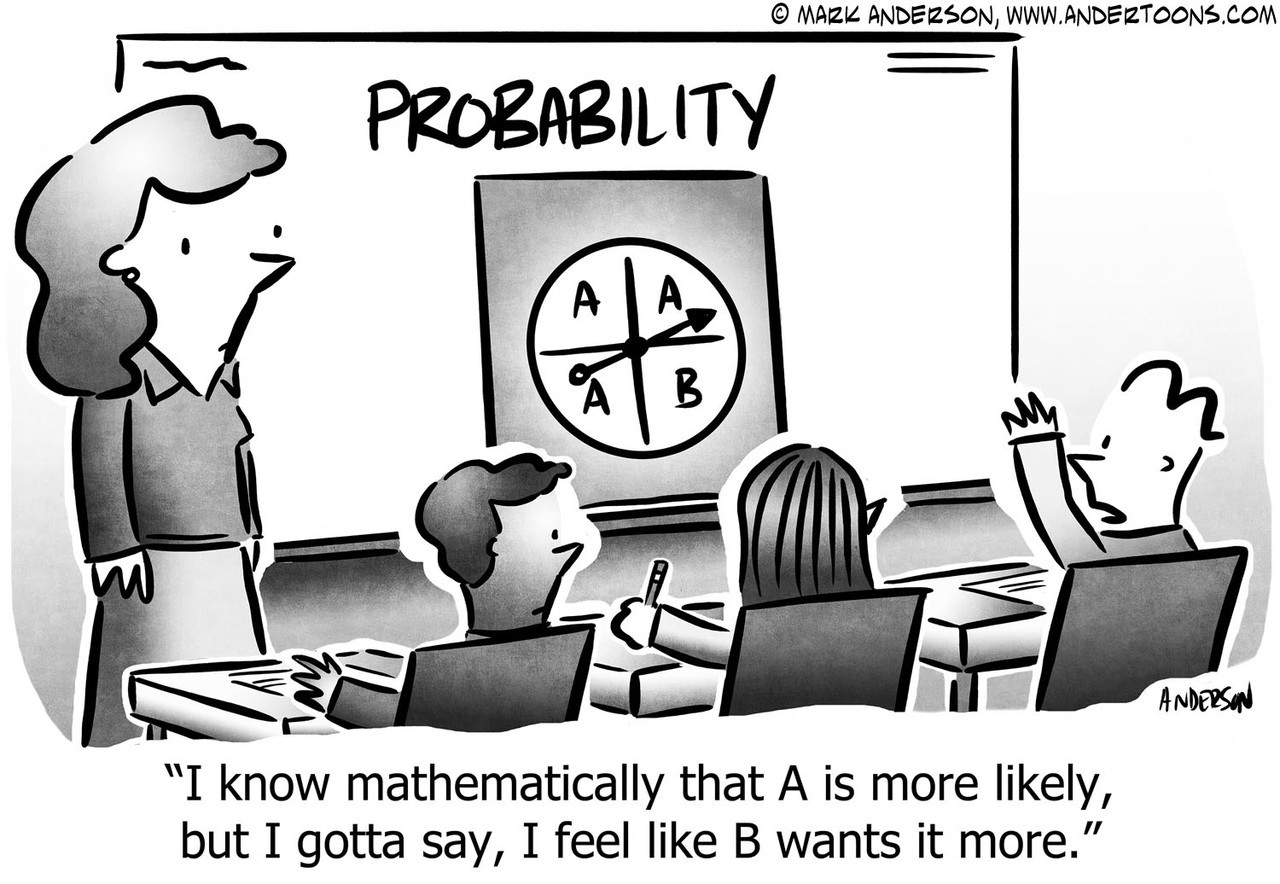
As a math major and former math teacher, I can comfortably say that a course on Probability and Statistics is the most important advanced math class we can take. Such a class is far more important and relevant in daily life than Calculus.
Unfortunately, many students don’t take Probability and Statistics in either high school or college. Even more unfortunately, many of us who have taken such a class ignore the concepts we learned in class when we make decisions in our personal and business lives.
Why Do We Ignore These Concepts?
Key concepts of Probability and Statistics are often ignored because it is quicker, easier (and more satisfying) to make decisions using our intuition. This leads us to being fooled by randomness, incomplete data, and bias. When used, probability and statistics give us a set of tools to correct for these failings of our human intuition.
Valuable (and Ignored) Concepts
Below and in the next three blogs I offer a list of ten key concepts in probability and statistics that are taught in class and widely known. But these concepts are almost completely ignored when people leave the classroom and make important decisions. In this blog, I start with the first two concepts.
1. The Base Rate: Ignoring the base rate is arguably the single most costly statistical failure in everyday life. People fixate on vivid, specific information and completely ignore the background probability.
A medical test for a disease is 99% accurate. You test positive. What’s the probability you have the disease?
Most people say 99%. The real answer would be less than 10% if the disease is rare (in the case where the disease only affects 1 out of 1,000 people). Doctors, judges, investors, and executives get this wrong constantly — and it has life-altering consequences.
The base rate comes from Bayes Theory in probability which requires us to consider both the specific evidence (positive test on a 99% accurate medical test) and the prior probability (the disease affects 1 out of 1,000 people). The vivid information of the positive test result crowds out statistical background rates.
2. Regression to the Mean: Extreme outcomes — good or bad — are partly due to luck, and luck doesn’t repeat. The next result will almost always be closer to average. The real consequences of ignoring regression to the mean include:
- Punishing an employee after a bad quarter, then “proving” punishment works
- Buying a stock after a spectacular year
- Firing a coach after a bad season that was mostly variance or bad luck
We ignore regression to the mean because we want to assign causes to outcomes. “Something changed” is more satisfying than “luck fluctuated.” A hot hand in sports or a hot streak in business usually cools off.
To Be Continued:
In the next blog, we will follow up with the next three ignored concepts from Probability and Statistics:
- Survivorship Bias
- Confidence Intervals Over Point Estimates
- The Difference Between Statistical and Practical Significance


